How to Reply on Hinge When She's Cautious About Sharing Her Address
Reply to a Hinge match who says she's cautious about sharing her address without sounding pushy. What to do, what to avoid, and when to move on.
When someone says she's cautious about sharing her address, she is telling you two things at once. She likes you enough to keep talking, and she isn't ready to give out personal location details yet. Most people who hear this read it as a rejection or a test, and then either push harder or go quiet. Neither helps. The message is ordinary safety caution, the same caution most women apply to strangers online, and it says very little about you specifically.
What a good reply does is accept the boundary without making it a topic. You want her to feel that you heard it, didn't need a justification, and are fine continuing the conversation somewhere else. If your reply treats the address as the thing you were heading toward, you've made the boundary the main event. If it treats the boundary as normal and moves the conversation forward, she gets room to relax and decide on her own pace.
The practical goal is to keep the match alive and let her set the next step. Meeting in public, sharing a first name and general neighbourhood, or switching to a phone call are all things that can come later. Asking for her address is the step she has already said she isn't ready for.
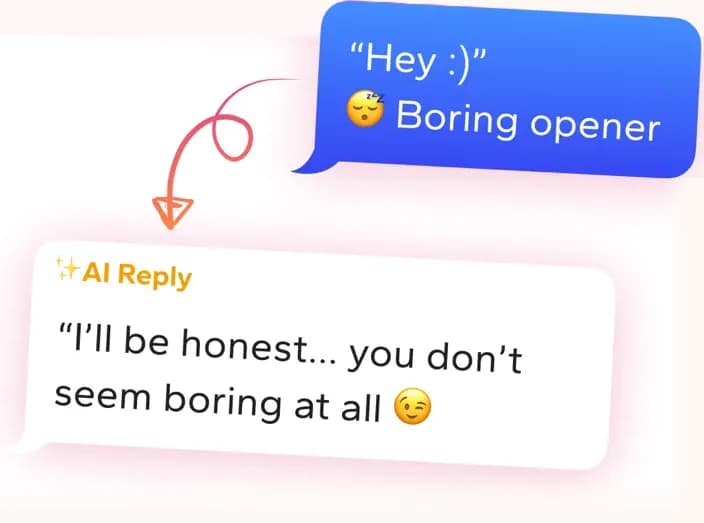
Get replies that sound like you
Screenshot the conversation in WingAI. It reads the vibe and gives you natural replies for this exact situation.
Try for freeHinge AI Screenshot the prompts and get a comment written for that profile.
Read it as ordinary caution, not a verdict
Her line is almost always a generic safety rule. Many women share their home area only after a few dates, sometimes after a first meeting, and they will say it outright because it's easier than dodging. The phrase 'this early' tells you she expects the conversation to keep going and is setting a pace. It is not a signal that she's losing interest or that you did something wrong.
Look at what else she wrote. If she asked you a question, kept her tone warm, or said she was happy to keep chatting, she is still in the match. If her reply was a one-word answer with no question back, that's a weaker signal and you should keep your next message shorter. Either way, your job is to answer the thing she actually wrote and leave the address question where she put it.
Answer the boundary, then give her an easy question
A good reply does three things in roughly this order. First, it acknowledges that the boundary is fine in a single short clause, so she knows you aren't hurt or pressing. Second, it returns to the conversation with something concrete to answer, usually a question about her life or a point you can add to what she said. Third, it stops. You don't explain your own safety habits, you don't reassure her at length, and you don't circle back to the address.
The question matters because it gives her a reason to keep writing that isn't about her personal details. Pick something she can answer quickly and enjoy talking about, tied to something already in her profile or messages. A reply that is warm, brief, and then hands her the next topic lets the match continue without any extra negotiation.
Wait a day, then let the chat decide
Reply within a normal window for the app, usually the same day or the next morning. Replying at 2am or leaving it four days signals either eagerness or indifference, and both colour how she reads the boundary. Once you've replied, don't send a follow-up about the address or a second message to check she's fine. If she answers warmly, keep going at the pace she sets.
If she goes silent after your reply, wait about three days before sending one light message on a different topic. If that gets no response either, stop. Don't send a third message, don't leave a 'hope you're well' line, and don't re-open the address question. Silence after a boundary is her answer, and it's not worth trying to win back.
Why these replies fail
“Totally fair! Mine's a bit more open, I'm in Shoreditch if that helps. Where are you based?”
Offering your own location as a trade makes the boundary into a negotiation and tells her the address question is still open.
“Haha no worries, I'm not going to come round with a shovel. Just curious where you're at!”
The joke brings up the safety worry explicitly, so it sounds like you're reacting to it instead of letting it go.
“Oh ok. Why are you cautious? Have you had a bad experience?”
Probing for her reasons turns a simple boundary into a personal story she now has to explain to a near-stranger.
Common mistakes
- Asking why she won't share it, which turns a safety boundary into something she has to defend.
- Offering your own address or a 'fair trade' as proof of good faith.
- Making a joke about her being paranoid or a serial killer, even as a light tease.
- Going quiet for two days after her message, which reads as you being put off.
- Replying with a long paragraph that mostly reassures her, which makes it feel like a bigger deal than it is.
Questions people ask
- Is it a bad sign if she won't share her address on Hinge?
- No. Not sharing a home address early is standard safety practice, especially for women who meet people online. It says she wants to take things slowly, not that she's uninterested. What matters more is whether she keeps replying, asks questions back, and seems warm in the conversation.
- Should I tell her I'm not offended?
- A short clause is enough, something like 'totally fine' or 'makes sense'. Anything longer, like a paragraph about how you'd never pressure anyone, makes the boundary feel like a big moment. Acknowledge it in a few words and move on to a new topic.
- When is it reasonable to ask where she lives?
- Usually not until you've met in person a few times, and even then a general area like a city or neighbourhood is enough. Let her offer more. If you're planning a date, suggest a public place and let her choose whether to share anything else about where she is.
- What if she says she's cautious but then stops replying?
- Send one light message on a different topic after about three days. If there's still no response, let it go. Don't send follow-ups about the address or ask whether you did something wrong. Silence after a boundary is a clear answer.
What people say after using WingAI
“I overthink every text. Having three options and picking the one that sounds like me cut that spiral short.”
Sam R.
“I was skeptical at first. Then I tried it on a dry chat and the replies actually sounded like me, not a chatbot.”
Mazoonx
“I'm busy and half the profiles give you almost nothing to work with. WingAI gets me a solid first line fast without me staring at the screen for ten minutes.”
Ralph
Get replies that sound like you
Screenshot the conversation in WingAI. It reads the vibe and gives you natural replies for this exact situation.
Try for free