What to say when he shares something vulnerable with you
How to reply when a guy opens up about something personal or painful. Build trust and show you're safe to confide in.
When someone shares something vulnerable, he's testing whether you're safe. He's exposing a fear, insecurity, failure, or part of his past. The stakes are higher than a normal text exchange because rejection or dismissal here doesn't just sting, it confirms his worry that he shouldn't have said anything.
A good reply does two things at once: it shows you heard the specific thing he said, and it signals you're not going to weaponize it or make him feel stupid for sharing. You're not trying to fix him, diagnose him, or turn it into something about you.
The window matters. A fast, thoughtful reply shows this landed on you. A delayed, generic one suggests you didn't take it seriously. He's already nervous about having said it.
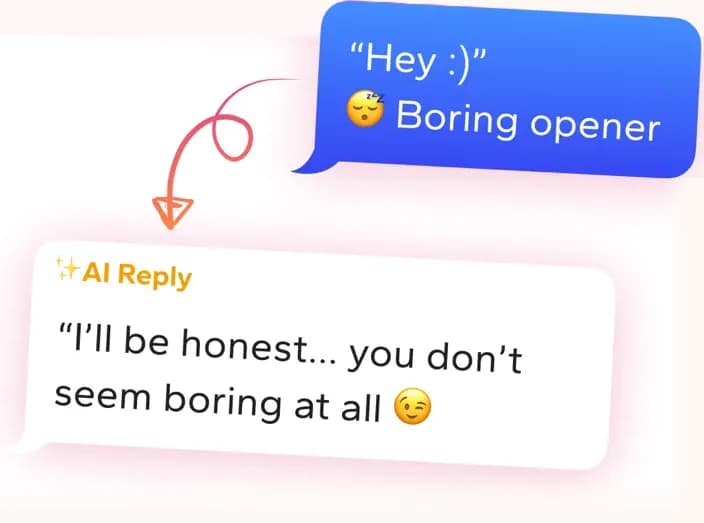
Get replies that sound like you
Screenshot the conversation in WingAI. It reads the vibe and gives you natural replies for this exact situation.
Try for freeRizz AI Screenshot the chat and get the next message for this person.
He's checking if you'll hold it without judgment
Vulnerability is a risk calculation. He decided the potential closeness was worth the potential rejection. That means he's watching your reply for signs you think less of him, that you'll gossip, or that you'll suddenly see him as broken.
What he's actually saying underneath is 'I trust you enough to show you this part.' The subtext matters more than the content. If he's telling you about anxiety or a failed relationship or shame he carries, he's not looking for you to solve it. He's looking for you to let him stay in the room with you while he admits it out loud.
Show you heard the real thing, not the problem
A good reply reflects back something specific from what he said, then creates space for him to feel however he feels about it. It acknowledges the weight of what he shared without trying to reframe it as smaller than it is.
The move is to name what you noticed, his honesty, how long he's carried this, that it still affects him. Signal safety. You're not offering solutions or reassurance that he'll be fine. You're saying 'this matters, you matter, and I'm not going anywhere because you told me this.' Keep it short. Overstuffing a reply with emotion or analysis can feel like you're performing rather than receiving.
Reply within hours, not days, and then let him lead
Send your reply when you can give it real attention, ideally the same day or next morning. A delay here reads differently than a delay on a casual text. He's already in the vulnerable space. A slow response feels like rejection.
After you reply, let him drive what happens next. He may drop it and move on, which is fine, or he may ask if you want to talk more about it. Don't keep circling back to it or keep asking if he's okay. That can feel like pity. If he goes quiet after you reply, don't panic or send follow-ups. He might just need to sit with having said it. If you don't hear back for days, a simple 'hey, thinking of you' once is enough. After that, move on and let him come to you.
Why these replies fail
“Wow, that's rough. Have you thought about seeing a therapist? They can really help with that kind of thing.”
It pivots straight to advice and problem-solving before he's felt heard, which makes him feel like his vulnerability is a problem for you to fix rather than something you can hold.
“Honestly I deal with the exact same thing so I totally understand. It's so annoying but you get used to it lol”
It hijacks his story and minimizes his experience by making it about you and adding false cheerfulness that denies the weight of what he shared.
“[seen at 2:47pm, no reply sent until 3 days later] 'Thanks for telling me that. I'm here if you need to talk :)'”
The delay signals discomfort or that it didn't matter much, and the generic phrasing feels obligatory rather than like you actually received what he said.
Common mistakes
- Turning it into advice mode ('have you tried meditation?' or 'you should talk to someone') before he's even finished feeling heard
- Making it about you ('oh my god I totally get it, I have the same thing') and taking over the story
- Going silent or taking too long to reply, which reads as discomfort or rejection
- Being overly cheerful or dismissive ('everyone gets anxious, you'll be fine') to lighten the mood
- Asking a bunch of follow-up questions like an interrogation instead of just receiving what he said
Questions people ask
- Should I ask more questions to show I care?
- Not right away. Let him sit in having been heard first. If he wants to say more, he'll keep talking. Asking a lot of questions can feel like interrogation and make him self-conscious about what he shared. If you're curious about something, ask it later in the conversation or a different day.
- What if I don't know what to say?
- Say less, not nothing. 'I'm really glad you told me this' or 'That makes a lot of sense' or 'That's heavy, I'm listening' are all fine. You don't need the perfect words. What matters is that you send something real and timely. Overthinking it delays your reply, which he reads as avoidance.
- Is it okay to acknowledge his courage for sharing?
- Yes, but not in a way that makes it sound surprising or like he passed a test. 'It takes guts to say that' or 'I appreciate you trusting me with this' works. Avoid 'I'm so proud of you for opening up' which can feel patronizing.
- What if he doesn't reply after I respond to his vulnerability?
- He might need time to process having said it out loud. He might be worried about how you reacted. Don't send follow-ups asking if he's okay or if you said something wrong. Give him space. If you haven't heard from him in a week, a casual 'hey' on a different topic is fine, but don't make it about the vulnerable share.
What people say after using WingAI
“I overthink every text. Having three options and picking the one that sounds like me cut that spiral short.”
Sam R.
“I was skeptical at first. Then I tried it on a dry chat and the replies actually sounded like me, not a chatbot.”
Mazoonx
“I always freeze on the first sentence. This gets me past that blank box so I actually hit send.”
joejoe4567
Get replies that sound like you
Screenshot the conversation in WingAI. It reads the vibe and gives you natural replies for this exact situation.
Try for free