What to text when she says she's stressed about work
What to text when she says she's stressed about work and needs a distraction. How to read it, what a good reply does, and when to follow up.
She's told you work is stressing her out and she wants something else to think about. That's a small disclosure, and it's also a request. She isn't asking you to solve the job. She's asking for a break from it, and she's judging whether you're someone she can relax around.
A good reply is simple. It acknowledges the stress in a line, then moves the conversation somewhere lighter that you both can hold. The distraction should feel like something you're offering her, not a lecture about work-life balance and not a pile of follow-up questions about her boss.
If you get this right, she ends up feeling a bit more like herself and a bit more interested in talking to you. If you get it wrong, she either keeps venting to someone else or feels like she has to manage your reaction on top of her day.
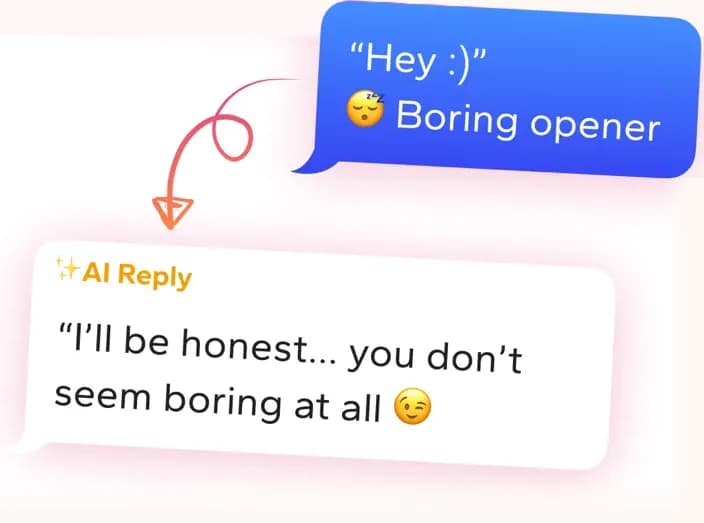
Get replies that sound like you
Screenshot the conversation in WingAI. It reads the vibe and gives you natural replies for this exact situation.
Try for freeRizz AI Screenshot the chat and get the next message for this person.
She's asking for a break, not a fix
When someone says work is stressing them out and they need a distraction, the message underneath is usually that they've already been thinking about it all day. They know the problem exists. What they haven't got is room to step outside it. Reading this right means noticing that the stress is the context and the request is for a change of subject.
Check the rest of her message for signals. A short, flat message usually means she's worn out and wants low effort from you. A longer message with some energy in it, even if it's about being annoyed, often means she wants to be drawn out a little. Match that level without copying her frustration.
One line on the stress, then a turn
The reply has to do two things. First, it has to show you heard that work is bad, in a sentence or less. Anything longer and you're centering the stress again. Second, it has to hand her something to do with her attention that isn't work. That could be a question about something you both like, a small plan, a story from your own day, or a playful prompt that asks her to pick.
Keep the handoff easy to answer. If the thing you offer takes effort to respond to, she'll likely skip it when she's tired. A question with a choice in it, or something she can react to with one line, works better than an open-ended ask about her weekend.
Stop when the mood changes
Once she's started answering the distraction, let the conversation run in that direction for a while. Don't keep circling back to work to check whether she's okay. If she mentions the job again on her own, respond to that briefly and return to the lighter thread. Trying to get her to unpack the stress after she's already shifted gears tells her the break didn't work, and she'll probably stop offering you the openings you were hoping for.
Why these replies fail
“Oh no, what happened? Did your boss say something? Honestly that sounds so unfair, you should push back on it.”
It pulls her straight back into the work problem with questions and advice when she asked for a break from it.
“Ugh same, my week's been a disaster too. Client changed the whole brief on Tuesday.”
It turns her request into a competition about who has it worse and keeps the conversation stuck on work.
“Poor you. Hope tomorrow is better. Let me know if you need anything.”
It acknowledges the stress and then ends the exchange, leaving her with nothing to pick up and no distraction at all.
Common mistakes
- Asking three or four questions about the work problem before offering any distraction
- Immediately giving advice on how to handle her manager or deadline
- Matching her stress with your own complaints so the conversation gets heavier
- Sending a joke so random it reads as dismissive of what she just said
- Waiting so long to reply that the moment she wanted a break from has passed
Questions people ask
- Should I ask her about the work thing at all?
- One brief acknowledgement is enough, such as saying that sounds draining. Then move on. If she wants to talk more about it she'll bring it up again, and you can respond when it happens. Asking follow-up questions about the details right away tends to keep her in the stressful part of her day rather than helping her step out of it.
- What if she just answers with one word?
- Take the one word as a sign she's tired, not as a rejection. Send something light that takes almost no effort to reply to, like a short joke or a simple question with a clear choice in it. If she still answers in one word, let it be a low-energy night and check back the next day with something easy.
- How long should I wait before I follow up?
- If she replied, you don't need to wait. Just keep the conversation going at her pace. If she went quiet after you sent your distraction, give it most of a day before sending anything else, unless it was clearly the end of an evening. A second message the same hour usually feels like pressure to someone who's already overwhelmed.
- Is it okay to send a meme or a photo instead of words?
- Yes, if it's something you'd find funny and it fits what she's been talking about. A meme works well as a break, but attach one short line so she knows why you sent it. A meme with no context can look like you didn't read what she wrote, especially when she's just told you she's stressed.
What people say after using WingAI
“She went cold mid-week and I had no idea what to say. The reply I sent felt natural and she picked the chat back up.”
Marcus T.
“I overthink every text. Having three options and picking the one that sounds like me cut that spiral short.”
Sam R.
“I was skeptical at first. Then I tried it on a dry chat and the replies actually sounded like me, not a chatbot.”
Mazoonx
Get replies that sound like you
Screenshot the conversation in WingAI. It reads the vibe and gives you natural replies for this exact situation.
Try for free