What to say when she texts she's worried she's too much for you
She texted that she's worried she's too much. Learn the tone to take, what to include, what to skip, and how to read her next message without overdoing it.
When a woman you're seeing sends a message about being too much, she has usually been sitting on it for a while. Typing it out is a small risk. She put a soft spot on the table to see whether you flinch. The wording sounds like a worry about herself, but the real question is aimed at you: if I stop editing myself, will you still be here?
That history matters. Plenty of people who say this have been told before, by an ex, a parent, a friend group, that their feelings took up too much room. They learned to pre-apologize. So the text often arrives right after she's shown you something real, like a bad day she didn't hide, a long voice note, or a night she wanted more attention than usual. The worry is a flinch after being seen, and it says more about what she's braced for than about anything you did.
Your aim is to make the moment feel safe without making it heavy. She doesn't need a speech or a rescue. She needs evidence that her honesty landed softly. That means taking her words seriously, giving her something specific and true about how you see her, and then carrying on with the normal rhythm of the conversation. Calm is the most reassuring thing you can offer, because it shows the disclosure didn't rattle you.
On a text thread, timing and length do a lot of the talking. A reply that comes after a day of silence reads as hesitation, and a reply that is five paragraphs long reads as panic. Aim for something warm, brief, and sent within a few hours. If you're mid-conversation already, answer in the same register you were using. Suddenly switching to a solemn tone makes the whole exchange feel like an incident, which is the opposite of what she's hoping for.
Most things backfire for the same reason: they answer the wrong question. Flat reassurance with no detail sounds like a script. Turning the spotlight onto your own insecurities pulls her into comforting you. Asking her to explain herself can feel like a cross-examination, and pushing the topic to a later in-person talk can feel like a door closing. Watch how she responds afterward. If she loosens up, jokes, or sends something more open, you hit the right note. If she doubles down or goes quiet, stay steady and consistent, and let a few ordinary, warm days do the persuading.
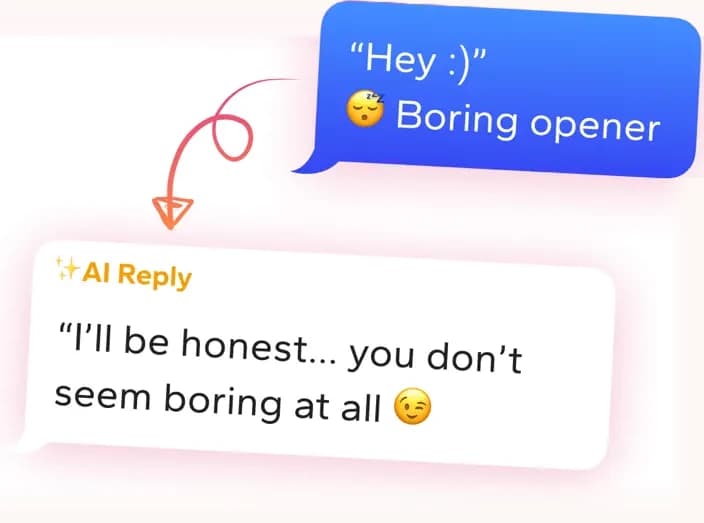
Get replies that sound like you
Screenshot the conversation in WingAI. It reads the vibe and gives you natural replies for this exact situation.
Try for freeChoosing a tone she can relax into
Match her temperature, then lower it slightly. If her message was shy and a little joking, you can be light back. If it sounded raw, be plainer and softer, with no performance. Avoid the tone of a counselor or a hero. You're a person who read something vulnerable and isn't bothered by it. Short sentences help. Skip exclamation-heavy enthusiasm, which can feel like you're overcompensating, and skip heavy gravity, which can feel like you've diagnosed a problem. Aim for the voice you'd use if she'd told you something in person and you leaned in with a small smile. Warm, unhurried, a bit direct.
What to put inside your reply
Start by showing you read her words and took them in, with a short acknowledgment of what she described rather than a pat denial. Then add one concrete thing you like about how she is with you, ideally tied to something that happened, like how she was on your last date or a moment in your texts that made you laugh. A specific callback proves you've been paying attention and that her real self has already been working in her favor. Close with a normal forward step, a plan, a question about her week, or a joke you share. The forward step tells her nothing changed.
Phrases that make her shrink again
Be careful with anything that sounds like a verdict: telling her she's wrong to feel that way, or listing reasons she shouldn't worry. It dismisses the feeling and invites her to defend it. Be careful with comparisons that center you, such as describing your own anxieties at length, because she'll end up managing your emotions. Skip dramatic vows about forever, which feel like pressure. Skip teasing that treats the worry as a quirk. And avoid asking her to justify it in the same message. Each of these quietly confirms her fear that sharing leads to a hassle.
What not to send
“you're never too much, stop worrying about that”
It orders her out of a feeling she just risked naming, so she learns that bringing it up gets her corrected instead of heard.
“honestly I get anxious about this stuff too, I always think I'm bad at relationships”
It turns her vulnerable moment into your confession and leaves her with nothing to lean on, so she ends up reassuring you.
“lol we can talk about it when I see you”
Pushing it off dodges the exact moment she reached out and reads as discomfort, which is what she was bracing for.
Mistakes to avoid
- Writing a long, emotional reply that treats her message as a crisis, which makes her feel she has to manage your reaction on top of her own worry.
- Swinging into extra gentleness for days afterward, so she senses you now see her as fragile and starts censoring herself even more.
- Using her vulnerability as a chance to deliver a speech about the future instead of simply showing, in ordinary ways, that you're still around.
Frequently asked
- How fast should I reply when she says she's worried she's too much?
- Within a few hours if you can. A long gap after a vulnerable message can read as you pulling back, and she may fill the silence with her worst assumption. You don't need to drop everything. Just don't let it sit overnight, and send something short and warm.
- Should I tell her she's not too much?
- Not as a bare line. A flat denial sounds automatic and skips what she told you. Acknowledge her concern, then show through something specific you like about her that you aren't put off. Evidence from real moments carries more weight than a blanket statement.
- What if I don't know what she means by too much?
- You can leave the definition alone for now. Respond to the feeling behind it. If she wants to explain, she'll expand on her own, and a relaxed question later, in person or at a calmer moment, lets you learn the details without making her defend herself over text.
- Do I bring it up again later?
- Usually no, not as a formal follow-up. Revisiting it can turn a passing disclosure into a big event. Instead, let your behavior carry the answer: reply as usual, make plans, stay warm. If she raises it again, respond to what's in front of you without repeating the earlier conversation.
Real user feedback
“I was skeptical at first. Then I tried it on a dry chat and the replies actually sounded like me, not a chatbot.”
Mazoonx
“She went cold mid-week and I had no idea what to say. The reply I sent felt natural and she picked the chat back up.”
Marcus T.
“I overthink every text. Having three options and picking the one that sounds like me cut that spiral short.”
Sam R.
Get replies that sound like you
Screenshot the conversation in WingAI. It reads the vibe and gives you natural replies for this exact situation.
Try for free