What to Say When She Says She Wants to Take It Slow
Know what to say when she says she's open to meeting but wants to take it slow. How to read the signal, reply without pushing, and time your follow-up.
When someone says she's open to meeting but wants to take it slow, she's telling you two things at once. She's interested enough to keep talking, and she's not ready to be pushed into a plan. Often the 'slow' part is about not wanting to feel rushed, not a polite no. Sometimes it's a soft brush-off, and the way she phrases it and what she does next will usually tell you which.
A good reply does three things: it takes her at her word, it gives her something concrete to respond to without a big commitment, and it keeps the door open without asking her to decide anything right now. Most people fail because they either fight the pace ('why slow?') or swing the other way and agree so eagerly it sounds like they're fine with anything.
What you're really trying to achieve is a conversation that moves forward on her terms without you disappearing or hovering. If she's warm, that shows up as her asking you questions back. If she's lukewarm, you'll see shorter answers and longer gaps. Your reply should make it easy for her to keep the momentum she wants.
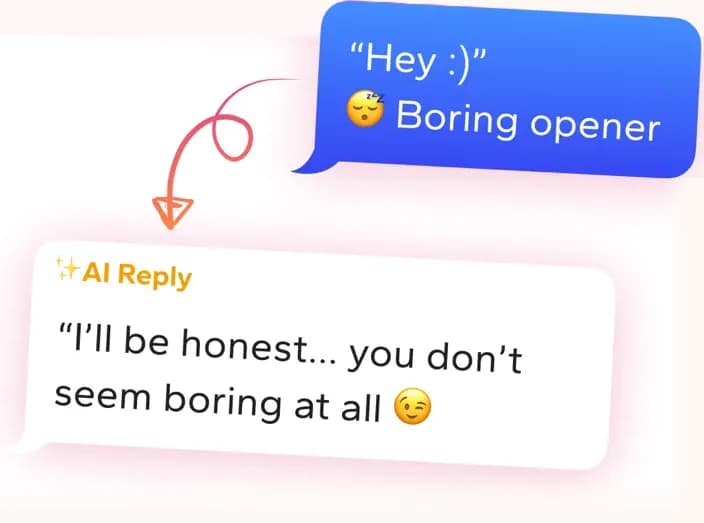
Get replies that sound like you
Screenshot the conversation in WingAI. It reads the vibe and gives you natural replies for this exact situation.
Try for freeRizz AI Screenshot the chat and get the next message for this person.
Read the slow part as information, not a verdict
When she mentions a past burn or says she wants to take it slow, she's usually describing her own pace preferences, not rejecting you. The phrase 'open to meeting' is the important half. She has already told you she's not closed off. What she's uncertain about is speed, and that's a much smaller problem than a no.
To read it accurately, look at the rest of the message. A warm, specific sentence after the caveat suggests real interest. A single flat line followed by a topic change suggests she's cooling. Also notice how much she shared. People who want distance usually give short replies. People who want to go slowly but still like you tend to share a bit more, even if it's a little vulnerable.
Give her a small next step, not a plan
The move here is to match her pace while still moving the conversation somewhere. Acknowledge what she said in a sentence, without turning it into a heavy moment. Then offer one low-stakes step that fits a slow approach, such as continuing to talk this week or a short call before any meeting, and frame it as something she can say yes or no to easily.
Avoid anything that asks her to define the relationship, commit to a timeline, or explain her past. Keep the ask light enough that saying yes costs her nothing. The reply should leave her feeling she set the pace and you respected it, while the conversation still has somewhere to go.
Let the week of silence speak before you do
After a reply like this, the usual mistake is texting again within a few hours to check whether you got it right. Give it at least a day, and ideally two or three, unless she's been replying quickly all along. A slow-paced person often answers when she has a free moment, not on a schedule matched to yours, so a quiet afternoon means very little.
If she replies warmly, match her energy and keep going. If she goes quiet for a week or more after you've followed up once, let it end. Send one gentle message at most, something that gives her an easy out, and then stop. If she never responds, that is your answer. Don't chase her with a third message or a sudden change of tone.
Why these replies fail
“Totally get it, but can I ask what happened before? Want to make sure I'm not going to be another one of those guys.”
It asks her to unpack her past at the exact moment she asked for space, which turns a pace preference into an interrogation.
“Cool! Let's do Friday night then, I know a great place. 7pm?”
It ignores that she asked to go slow and locks in a specific date, so she either has to back out or cave.
“I really respect you for being so honest. That takes real courage and I think it says a lot about you. Anyway, I'm really looking forward to getting to know you!”
The heavy praise and the 'looking forward to' line add pressure dressed as warmth, and make the conversation feel bigger than she wanted.
Common mistakes
- Asking her to explain why she wants to go slow, which puts her on the defensive
- Immediately proposing a specific date as if her caution wasn't said
- Over-agreeing with lots of praise for her honesty, which can read as pressure in disguise
- Going quiet for days after her reply because you're worried about getting it wrong
- Matching her caution with a long paragraph about your own dating history
Questions people ask
- Does 'open to meeting but want to take it slow' mean she's not interested?
- Usually not. Saying she's open to meeting signals real interest, and 'take it slow' is about her pace. Check the rest of her message and how warm her later replies are. Warm, specific replies mean she's still in. Short, flat replies mean she may be cooling, even if she never says so.
- How slow is slow enough? Should I wait before suggesting a date?
- There isn't a fixed number. Let the conversation tell you. If you've been chatting for a week or two with good back and forth, a low-pressure suggestion like a short call is usually fine. Avoid naming a specific date until she has shown she's comfortable with the idea of meeting, even in a general way.
- What if I'm worried I'll lose her by going too slow?
- Going slow rarely loses someone who is interested. What loses people is hovering, sending a lot of messages, or making the pace feel like a test. Keep your messages steady and warm, and let her set the rhythm. If she's worth pursuing, she'll keep talking at a pace that works for both of you.
- Should I tell her I'm also not in a rush?
- A brief, honest line like 'no rush from me either' can help, as long as it's not overdone. It tells her you're not pushing. Don't add a long explanation of your own dating history or preferences, because that shifts the attention away from her and makes the moment feel heavier than it needs to be.
What people say after using WingAI
“My openers used to be boring. Now I reference something from her profile and people actually write back.”
Aiden K.
“I was skeptical at first. Then I tried it on a dry chat and the replies actually sounded like me, not a chatbot.”
Mazoonx
“Used it for a couple hours and set up a date the same night. Not even kidding.”
Nikola2214
Get replies that sound like you
Screenshot the conversation in WingAI. It reads the vibe and gives you natural replies for this exact situation.
Try for free