What to say when he shares something heavy before you're close
He's opening up too fast. How to respond warmly without overdoing it or shutting him down.
When someone texts you something personal or sad early on, he's either testing the waters or actually struggling and reaching for connection. Either way, there's a mismatch: you don't have the history yet to hold that kind of weight together. Your reply matters because it sets the tone for what kind of relationship this becomes.
A good reply says "I see you" without saying "Tell me everything" or "That's heavy, I'm not ready." You want to acknowledge what he shared, show you're listening, and leave the door open without committing to being his emotional anchor before you've even met or had a few real conversations.
The trap is either going cold, which makes him feel rejected for being vulnerable, or going deep, which creates false closeness that collapses when real life starts. Neither works. You're aiming for something in the middle: warm, present, and boundaried.
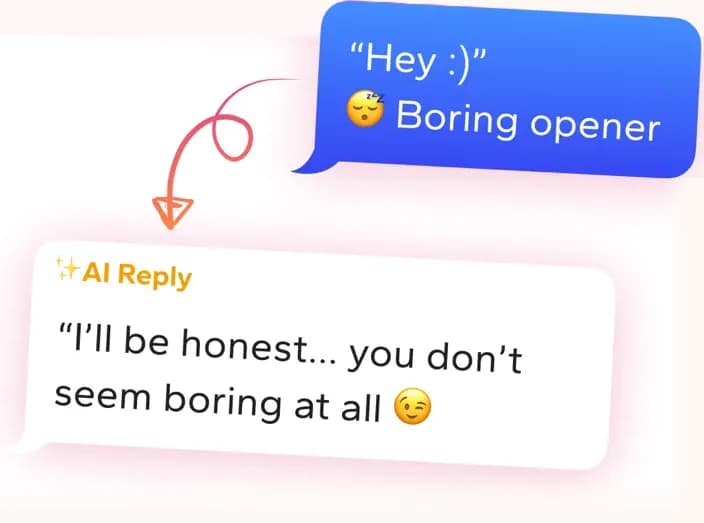
Get replies that sound like you
Screenshot the conversation in WingAI. It reads the vibe and gives you natural replies for this exact situation.
Try for freeRizz AI Screenshot the chat and get the next message for this person.
He's either testing your empathy or reaching out in real time
Sometimes early vulnerability is calculated. He's checking if you're the kind of person who listens and cares. Other times he's just having a bad day and instinctively texted someone who seemed warm. Both are normal. What matters is that you don't have context yet. You don't know if this is his baseline or a rough week. You don't know if he processes sadness by talking it out or by pretending it isn't there. You don't know him well enough to know what help actually looks like.
That's the real situation: he's shared something real, but the relationship is still hypothetical. Your job is to honor the sharing without pretending the closeness is further along than it is.
Acknowledge it, be brief, stay present without diving in
A working reply does three things. First, it shows you actually read what he said and it registered. Not a generic response, not a redirect. Something that proves you were listening. Second, it leaves room for him to say more if he wants to, without you prompting him for details. Third, it doesn't position you as his therapist or his cheerleader. You're not solving anything or minimizing anything. You're just there for the message he sent, right now.
Don't ask him to elaborate on the sadness. Don't tell him it'll get better. Don't make promises about future conversations where you'll really dig into this. Just show up cleanly and move the conversation back to something you can actually build together.
Send it soon, but don't manufacture urgency you don't feel
Reply while his message is still fresh, ideally within a few hours. Not because you need to sprint to prove you care, but because delayed responses to something vulnerable can read as avoidance. A same-day reply says "I got this, it matters that you said it."
If he doesn't follow up after your reply, don't panic or chase. He might need space. He might be embarrassed he overshared. Let a day or two pass, then text him something normal and unrelated to the sadness. If he engages, great. If he stays quiet, he's probably processing or realized he moved too fast. Don't keep circling back to the heavy thing. At some point you're no longer being supportive, you're just reminding him he confessed to a near-stranger.
Why these replies fail
“Oh no, that sounds really hard. Do you want to talk about what's going on? I'm here if you need to vent.”
This creates therapist-like availability and invites him to keep dumping before you've established actual rapport, which builds false closeness.
“That sucks. Anyway, I'm thinking about grabbing coffee this weekend if you want to meet up?”
It dismisses what he said and pivots too aggressively, signaling you don't want to hear anything difficult from him.
“I hear you. I've been through work stress too and it's the worst. I basically just powered through and stopped checking email after 9pm. You should try that.”
Centering your own experience and offering unsolicited advice makes it about you, and suggests his struggle needs fixing rather than witnessing.
Common mistakes
- Matching his intensity by asking follow-up questions about the sadness, which accelerates emotional bonding before you know him
- Offering advice or solutions, which puts you in a caregiver role he didn't ask for
- Pivoting away entirely with a cheerful topic, which reads as dismissal
- Saying 'I'm here for you' or similar statements that promise support you can't actually give to a stranger
- Over-explaining why you're not diving deep, which sounds like rejection
Questions people ask
- Should I ask him if he's okay or just ignore the sad part?
- Don't ignore it, but also don't interrogate it. Acknowledge the weight of what he said in one line, then either ask an open question that lets him decide how deep to go, or just move the conversation forward naturally. The middle ground is recognizing his words landed, without demanding he expand.
- What if this keeps happening and every conversation gets heavy?
- After the second or third time, you can gently redirect. Text something like 'Hey, I notice we jump into heavy stuff pretty quick. I'd like to get to know your lighter side too before we're deep in the serious stuff.' If he can't do that, he might not be ready to date casually right now.
- Does responding warmly mean I'm leading him on?
- No. Being kind to someone who's struggling is not a promise of romance. You can care about someone's feelings without committing to their emotional journey. A warm, boundaried reply is honest. It's the over-promise of availability that leads people on.
- How long should I wait to bring up meeting in person after he shares something sad?
- Wait at least a couple of normal conversations after the heavy text. You want to establish some lighter rapport and make sure he's not only looking for emotional support. Once things feel balanced again, suggest a meet-up as you normally would.
What people say after using WingAI
“I was skeptical at first. Then I tried it on a dry chat and the replies actually sounded like me, not a chatbot.”
Mazoonx
“She went cold mid-week and I had no idea what to say. The reply I sent felt natural and she picked the chat back up.”
Marcus T.
“I overthink every text. Having three options and picking the one that sounds like me cut that spiral short.”
Sam R.
Get replies that sound like you
Screenshot the conversation in WingAI. It reads the vibe and gives you natural replies for this exact situation.
Try for free