What to say when he avoids commitment talk and you need clarity
How to push for honest answers when he seems scared of commitment. Direct replies that cut through avoidance without ultimatums.
When someone dodges commitment conversations, they're usually afraid of losing freedom, disappointing you, or admitting they don't want what you want. His avoidance isn't neutral. It's information. A good reply names what's happening without accusation, makes it safe for him to be honest, and clarifies what you actually need from him.
Your goal is not to convince him into commitment. It's to get a real answer so you can make a real decision. That means separating his fear from his actual position. Does he want commitment but feels trapped by timing or past hurt? Or does he not want it at all? Those are different problems.
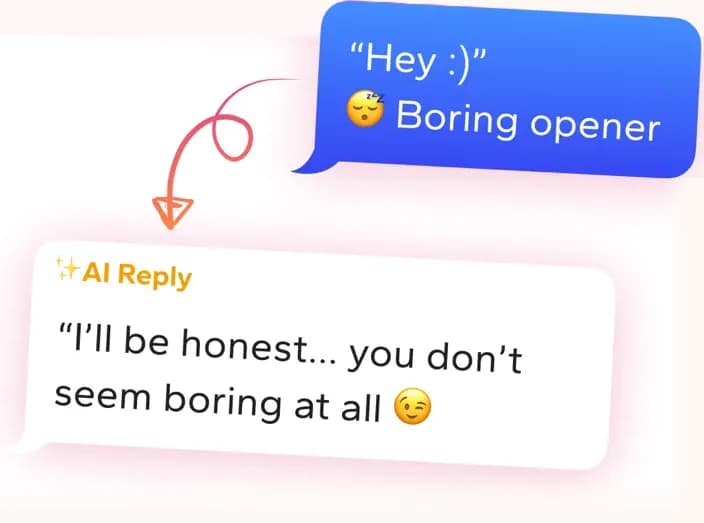
Get replies that sound like you
Screenshot the conversation in WingAI. It reads the vibe and gives you natural replies for this exact situation.
Try for freeRizz AI Screenshot the chat and get the next message for this person.
The difference between scared and unwilling
Fear of commitment and refusal to commit look the same in texts, but they need opposite responses. A scared person will dodge the conversation but show up in small ways. He texts first sometimes. He makes plans past next week. He uses your name. He asks about your day. An unwilling person maintains distance while keeping you interested. He texts late. He avoids future plans. He talks about himself mostly.
If he's scared, he needs permission to be honest. If he's unwilling, he needs to know that unclear is a dealbreaker. Read his pattern before you reply. One conversation won't change someone who doesn't want commitment. But one honest conversation can get through to someone who's just afraid.
Name what he's doing and ask for specifics
A good reply does two things. First, it calls out the pattern clearly and calmly, no anger or sarcasm. You're saying what you've noticed. He pulls you in, then pulls back. He says he's not ready but keeps texting. He changes the subject when it gets serious. This isn't accusatory. It's just factual.
Second, you ask for a specific answer to a specific question. Not how he feels. Not what he wants long-term. Ask this: Are you willing to try a real relationship with me, or not? That's it. A yes, no, or honest maybe. If he gives you anything else, that's your answer too. Refusal to answer is an answer.
Send this when you're ready to hear a no
Do not have this conversation over text when you're hoping to persuade him. Send it when you're actually prepared to walk if he says no or stays unclear. He'll feel that readiness and it will matter. Ambivalent people often become clear once they realize the status quo is ending.
Give him 24 to 48 hours to respond. If he doesn't, send one follow-up that's short and direct: 'I need an answer on this. Let me know.' After that, stop initiating. If a week passes with silence or deflection, he's told you what you need to know. Move on.
Why these replies fail
“I feel like maybe you're scared of commitment? I get it, that's okay. We can take it slow and see where it goes.”
You're diagnosing his emotion instead of asking for his choice, and you're offering to make it easier for him to keep avoiding the answer.
“You know I really like you. I just want to know if there's a future for us. What are you feeling?”
This is too soft and open-ended. He can respond with a feeling instead of a decision, and you're back where you started.
“So are we ever going to be official or are you just going to keep stringing me along like this?”
Anger and blame make him defensive instead of honest. He'll either justify himself or disappear rather than give you a real answer.
Common mistakes
- Asking open-ended questions that let him stay vague (how do you see this going, what are you looking for)
- Softening your language to make him comfortable, which signals you don't expect a straight answer
- Treating his avoidance as shyness instead of what it actually is. A choice to keep things unclear
- Asking him to explain his feelings instead of asking what he actually wants from you
- Waiting passively for him to bring it up again instead of setting a deadline for the conversation
Questions people ask
- Should I give him an ultimatum?
- Not exactly. An ultimatum is a threat. What you're doing is setting a boundary. Unclear is not acceptable to you. The difference matters. A boundary is about your own actions. You're saying 'I need clarity so I can decide what to do,' not 'decide now or else I'll leave.' He then chooses.
- What if he says he needs more time?
- 'More time' is stalling. Ask him to be specific. More time to do what, and for how long? If he can't answer, that's meaningful information. A person who wants you will find reasons to commit, not reasons to wait.
- Is it possible he actually doesn't know what he wants?
- Maybe. But that's still information. If he doesn't know after months of dating you, that's not a reason to stick around. He's either unable or unwilling to get clarity on his own feelings, which is a separate problem you can't solve for him.
- What should I do if he goes silent after I ask?
- Silence is an answer. It means he doesn't want to face the question and doesn't care enough about you to try. After one follow-up attempt, stop texting. Let him break the silence if he wants to. If he doesn't, you have your clarity.
What people say after using WingAI
“I overthink every text. Having three options and picking the one that sounds like me cut that spiral short.”
Sam R.
“I was skeptical at first. Then I tried it on a dry chat and the replies actually sounded like me, not a chatbot.”
Mazoonx
“She went cold mid-week and I had no idea what to say. The reply I sent felt natural and she picked the chat back up.”
Marcus T.
Get replies that sound like you
Screenshot the conversation in WingAI. It reads the vibe and gives you natural replies for this exact situation.
Try for free