How to reply when he's worried you'll lose interest
He's expressing doubt about your staying power. Learn what this means and how to answer without over-reassuring.
When someone says he's worried you'll lose interest, he's signaling anxiety about the relationship's future. This usually means he's felt abandoned before, or he's picking up on distance from you that he can't quite name. The fear is real, but the phrasing is also a test. He wants to see if you'll panic, defend yourself, or actually address what's underneath.
A good reply doesn't dismiss his worry or flood him with promises. Instead, it names what's actually going on between you two and gives him something concrete to point to. It shows you're paying attention to the relationship, not just caught up in early momentum.
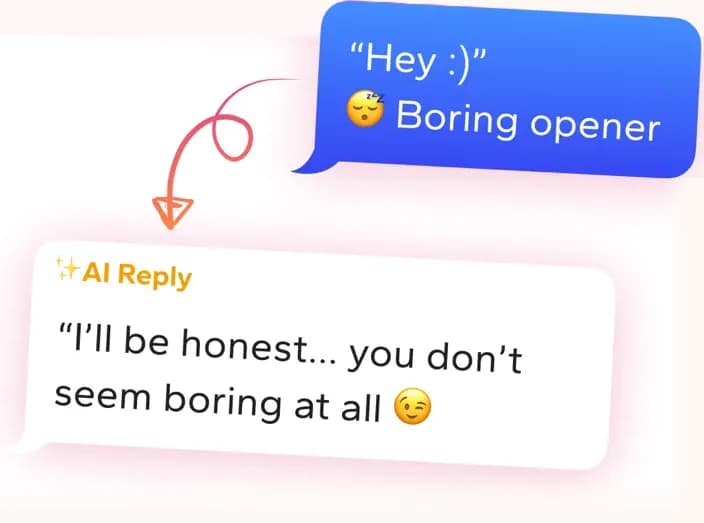
Get replies that sound like you
Screenshot the conversation in WingAI. It reads the vibe and gives you natural replies for this exact situation.
Try for freeRizz AI Screenshot the chat and get the next message for this person.
His worry usually points to a pattern he's lived through
When someone expresses fear about being abandoned or losing you, he's often remembering a specific experience where that happened. It could be an ex who faded, a parent who left, or past relationships that felt conditional. His brain is pattern-matching, not necessarily reading your signals accurately.
But sometimes he's picking up on something real. Maybe you've been less available lately, or the frequency of your contact changed. Either way, his statement is less about prediction and more about what he needs to know right now. He's asking if you're still in this.
Name the gap between his fear and what's actually happening
A strong reply does two things at once. First, it acknowledges that his worry exists and matters. Second, it points to specific evidence that contradicts the fear: something you've done recently, a pattern you've kept, a way you show up that's inconsistent with bailing.
You're not trying to convince him he's wrong to worry. You're showing him the actual data. Reference a recent moment, a consistency on your part, or a way you've prioritized him. Be specific enough that he can't argue with it. Then name what you actually want from here, so he knows you're not just soothing him in the moment.
Respond the same day, before he builds a story
Silence after this kind of vulnerability will convince him he's right to worry. Don't wait for the perfect reply or the right headspace. A direct message within a few hours shows you're not spooked by what he said and that you take it seriously.
If he doesn't respond after you've replied, give him 24 to 48 hours before a follow-up. Don't keep elaborating or reassuring. One solid message is enough. If he stays quiet beyond that, he may need space to sit with the answer you gave him, or the worry is connected to something deeper that texting won't fix. At that point, propose talking in person.
Why these replies fail
“That's not true at all, I'm really into you. This is different from my past relationships”
It's defensive and vague. 'Really into you' and 'different' don't give him anything real to hold onto. He'll interpret this as you not actually hearing his fear.
“Why would you say that? I've never given you any reason to think that”
Turning it back on him makes him feel accused for being vulnerable. He'll apologize instead of getting reassured, and the actual issue goes unaddressed.
“I don't know, do you think that's likely to happen? What's making you feel that way?”
Asking him to justify his fear puts the burden back on him when he was looking for you to step up. It sounds like you're interrogating him instead of meeting him.
Common mistakes
- Over-reassuring with vague promises ('I won't, I really like you') makes him feel unheard and often backfires
- Getting defensive or turning it around on him ('Why would you even say that?') shuts down what he's trying to communicate
- Asking too many questions without anchoring first ('What made you think that?' pushes him to justify rather than connect)
- Going silent or taking time to craft the perfect reply signals that his worry landed as a threat instead of a conversation
- Matching his uncertainty ('I don't know, maybe you're right') erases the actual connection you've built
Questions people ask
- Should I promise I won't lose interest?
- No. Promises about the future feel empty and put pressure on you. Instead, point to what you're actually doing right now that shows you're invested. Let your actions over time be the real answer, not words.
- What if he brings this up again a few weeks later?
- Repeated worry about the same thing suggests it's a deeper pattern for him, not about your actual behavior. You can name that gently. 'I've shown you where I stand. This seems like something you carry from before.' Then ask if he wants to talk about what's really driving it.
- Does this mean he doesn't trust me?
- Not necessarily. Trust is built over time. Early on, people often worry about the future because they haven't had enough evidence yet. If he keeps bringing it up after months of consistency, that's different. But one mention early on is often just fear, not a judgment on you.
- What if I'm actually losing interest?
- Be honest. Lying to soothe him will only delay a harder conversation later. If you're truly uncertain about him, say that. 'I care about you, and I'm figuring out what I want.' That's more real than false reassurance and gives you both room to breathe.
What people say after using WingAI
“I was skeptical at first. Then I tried it on a dry chat and the replies actually sounded like me, not a chatbot.”
Mazoonx
“She went cold mid-week and I had no idea what to say. The reply I sent felt natural and she picked the chat back up.”
Marcus T.
“I overthink every text. Having three options and picking the one that sounds like me cut that spiral short.”
Sam R.
Get replies that sound like you
Screenshot the conversation in WingAI. It reads the vibe and gives you natural replies for this exact situation.
Try for free