What to text your boyfriend after a long day at work
What to text your boyfriend after a long day at work: the tone, timing and details that get a real reply from someone who is tired and out of words.
By the time your message lands, he has usually spent hours answering emails, fielding requests, and holding his face in a neutral setting. What's left is a brain that wants quiet. That is why a text that looks perfectly sweet to you can feel like one more item on a list. He isn't weighing whether he loves you. He's weighing whether he has the fuel to answer, and most evenings the honest answer is barely.
Your aim is smaller than it feels. You are not trying to fix his mood, pull out a confession about his boss, or get a long reply. You want him to know you thought of him and to hand him something he can respond to with almost no effort. Think of it as leaving a light on in the hallway rather than knocking on his door. If he walks toward it, great. If he doesn't, the light was still on.
Texting changes the situation in a few ways. There's no voice to soften a clumsy line, so a short message can read colder than you meant, and a long one can read like a summons. Timing matters too. A text that arrives while he's still on the train or standing in the kitchen with his keys in hand competes with real life. One that arrives after he's eaten and sat down has a better chance. Pay attention to when his replies usually come, and let that pattern set your schedule instead of your own impatience.
Most of what backfires here shares a root: it asks him to do emotional work he has no budget for. Heavy declarations, vague worry, a pointed question about where you two stand, even a cheerful but empty greeting that makes him invent an answer. Each one shifts effort onto him at the moment he has the least to give. Another quiet trap is the double text. A second message sent because the first sat unanswered tells him the first one was a test, and he failed it.
Reading his reply takes patience. A short answer, a thumbs up, a single word, these usually describe his battery, not his feelings. Look instead at what happens across several days. If he comes back warmer the next morning, or picks up a thread you dropped, nothing is wrong. If the flatness holds across a week and he stops initiating anything, that's a conversation for a call or a face to face, not a text sent into his tired evening. Meet short replies with an equally easy tone and let the rhythm recover on its own.
Get replies that sound like you
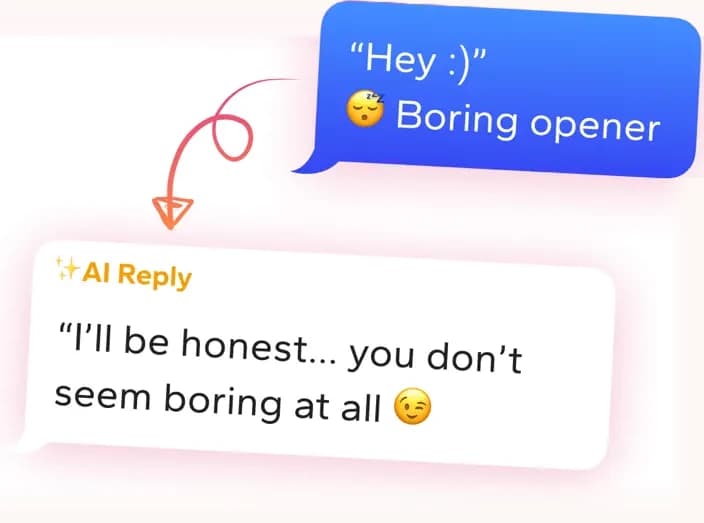
Screenshot the conversation in WingAI. It reads the vibe and gives you natural replies for this exact situation.
Try for freeWhy these replies fail
“I had the worst day ever and I just need you right now”
It turns his first free minute into an emergency shift, when he's already emptied out and can't give the comfort it asks for.
“So are we good? I feel like you don't care anymore”
A relationship check sent at his lowest point forces him to reassure you with no energy, and he'll remember the pressure more than the words.
“Hey how was work?”
It sounds friendly but hands him the whole job of producing an interesting answer, which is exactly what he has nothing left for after the workday.
Match his energy, then lower it
If he sends back something clipped, don't mirror it exactly and don't escalate. Aim slightly softer and slightly shorter than whatever he gave you. A flat reply from him calls for a relaxed, undemanding follow-up, not a paragraph of reassurance. If he sends something with a bit of life in it, a joke, a complaint about a coworker, you can lean in with a matching detail and a bit more warmth. The goal is to be a step easier to talk to than he expects. People who are drained tend to stay in a conversation that costs them nothing and drift out of one that costs something.
Callbacks beat fresh topics
Something he mentioned earlier in the week gives him a ready-made thread. If he told you about a tough presentation, a leaky car, a coworker who talks too much, or a show he's halfway through, referring back to it shows you were listening and removes the burden of explaining from scratch. He doesn't have to generate context, only react. Keep the reference light. Asking how the presentation went can feel like a quiz. Mentioning that you thought of him when something similar happened to you feels like company. Pick a detail that's easy and low stakes, not one tied to a source of stress.
Say you're tired too, plainly
If your own day was long, you can say so without turning it into a request. A flat statement about being worn out, or a small complaint about something minor, gives him permission to be tired without apology. It also makes the exchange feel mutual instead of one person performing energy for the other. The line to watch is the one between sharing and unloading. Sharing is a sentence or two he can nod at. Unloading is a wall of text that makes him feel he now owes you comfort. Keep it short, keep it about you, and don't attach a question that demands a thoughtful answer.
Common mistakes
- Using the after-work text to bring up a worry about the relationship, which hands him a heavy conversation exactly when he has the least capacity for it.
- Sending a long message full of your own day, which feels like a task he must answer in kind rather than an easy way back to you.
- Checking the read receipt and sending a follow-up within the hour, which turns a kind gesture into a demand for a prompt reply.
Questions people ask
- What if he replies with one word like 'good' or 'k' after work?
- Read it as a low battery, not a verdict. Don't push for more that evening. Let the exchange rest and pick it up lightly the next day. If his replies stay clipped for several days in a row, that pattern deserves a real conversation, not more texting.
- Is it okay to text him more than once if he doesn't answer?
- Send one message and leave it. A follow-up the same evening reads as pressure and makes the first text feel like a test. If nothing comes by bedtime, he likely saw it and had nothing left. Expect a reply tomorrow, and let that be fine.
- Should I wait for him to text first after he finishes work?
- Not if you normally start the conversation and he responds well. Keep doing what works. What matters is making your message easy to answer. If he never initiates at any time of day, that's a separate pattern worth raising in person.
- How can I tell if he's upset or just exhausted?
- Exhaustion shows up as slow or short replies on a bad day, then ordinary texting returns the next morning. Upset tends to last, with cooler tone and fewer attempts to connect across several days. One rough evening is rarely information. A full week of it is.
What users say
“I overthink every text. Having three options and picking the one that sounds like me cut that spiral short.”
Sam R.
“I was skeptical at first. Then I tried it on a dry chat and the replies actually sounded like me, not a chatbot.”
Mazoonx
Get replies that sound like you
Screenshot the conversation in WingAI. It reads the vibe and gives you natural replies for this exact situation.
Try for free