When she texts less often: what the shift from daily to once daily means
She used to text all day and now she replies once daily. Here is what the change can mean and how to answer without chasing her or pulling away.
When a woman who texted you all day starts sending one message every twenty four hours, the first thing worth asking is what that earlier pace was built on. Early contact often runs on novelty. Everything about you is new, so every text feels like an event. Once the novelty fades, people slide back toward their ordinary routine, and for many that means one longer exchange in the evening rather than a stream of small ones. That is a very different story from someone who has quietly started sorting you into a lower priority pile, and the frequency alone will not tell you which story you are in.
What you want from the next few weeks is information, not reassurance. You are trying to find out whether the connection has moved into a calmer rhythm or whether her interest is thinning. Those two outcomes look similar in the first week and diverge in the third. So your aim is to stay pleasant, stay visible, and keep collecting evidence without making her feel watched. If you push for an explanation now, you replace honest data with a polite, defensive answer.
Timing matters more here than on a dating app, where the conversation is short lived anyway. A once daily text usually arrives at a predictable hour, often after work or just before bed, and that predictability is useful. It means her silence at noon carries no meaning. A reply that lands twenty minutes after hers feels natural, while a flurry of follow ups at lunch, mid afternoon and again at ten feels like pressure stacked on top of a message she already answered. Let her window open, respond inside it, and then leave the rest of the day alone.
Most of what backfires comes from trying to make the drop mean something out loud. Pointing at it, joking bitterly about it, or answering with exaggerated distance all hand her a job she did not ask for. She now has to manage your feelings about her phone habits, and people tend to retreat from that. Guilt and sarcasm are the worst offenders because they turn a quiet pace into a confrontation she never agreed to have.
Reading her response comes down to texture. Look at whether her once daily message has substance, whether she asks you something back, whether she brings up a plan or a detail from your last chat. A single warm, curious message a day is healthier than three flat ones. Watch too for her initiating, even occasionally, and for any willingness to move things offline. If those appear, the slowdown is probably just settling in. If the messages shrink, questions vanish and plans stay vague, you have your answer without ever asking for it.
Why the early burst fades
The first stretch of talking to someone is unusually intense. Every message answers a question you both have about each other, so the pace feels urgent. Few people can hold that up alongside work, friends and sleep. A drop to one message a day is often what a normal routine looks like once curiosity has been partly satisfied. If you interpret the old pace as the baseline, anything lower will look like loss. Try treating the burst as the exception instead. Judge her by the tone of what she sends now, and by whether she still shows effort in small ways, like remembering what you told her last week.
Matching her window without hovering
Notice when her daily message tends to arrive. If it is usually mid evening, that is when she has attention to spare, so that is when a reply will be read properly. Answer within a reasonable stretch, but skip the habit of sending something in the morning just to stay on her mind. Starting a conversation yourself every second day is plenty. When you do, give her something easy to pick up, like a comment on something she mentioned or a small plan floated lightly. The goal is a conversation that feels roomy, not one that depends on her producing a response.
Spotting the difference between calm and cooling
A relaxed pace has warmth in it. Her messages run a few sentences, she mentions her day, she picks up threads you left. A cooling pace is thinner. Replies shrink to a line, she stops asking about you, and plans never get a day attached. Give this a couple of weeks before you decide, because one tired week proves nothing. Keep a loose mental tally of whether she has suggested anything in person, whether she reacts when you share good news, and whether her questions have gone from curious to polite.
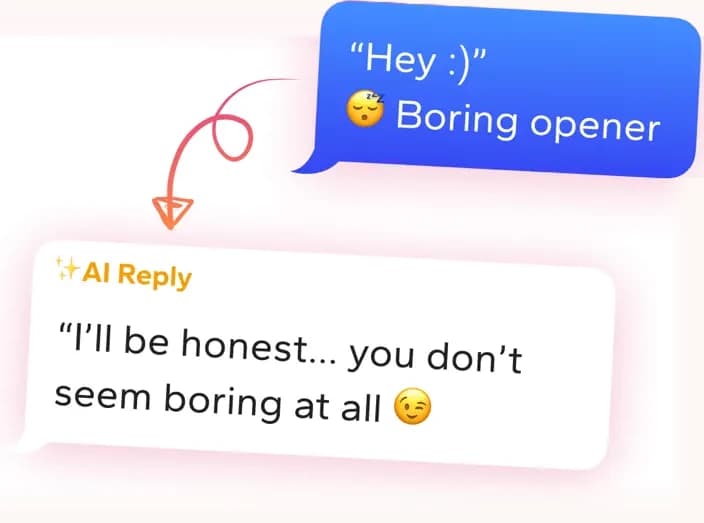
Get replies that sound like you
Screenshot the conversation in WingAI. It reads the vibe and gives you natural replies for this exact situation.
Try for freeTexting AI Screenshot the thread on your phone and get the next text.
Why these replies fail
“Wow, a text from you today, I almost forgot what your name looked like on my screen lol”
The joke has a sting under it, and since her once daily message is the thing you are mocking, she hears it as being punished for replying at all.
“Hey, just checking in again, did you see my messages from this morning and lunchtime?”
Stacking follow ups on top of a person who has already settled into one daily reply turns her calm window into an inbox she dreads opening.
“I noticed you text way less than you used to. What changed? Be honest with me.”
Demanding an explanation for a rhythm shift in the first week forces her to defend a pace she may not even have noticed, and her answer will be guarded.
Questions people ask
- Is texting once a day a bad sign when she used to text constantly?
- Not on its own. Early contact is usually the fastest it will ever be, and many people settle into a slower routine afterward. What matters is the quality of the daily message, whether she asks about you, and whether she is open to meeting. Warm and curious is fine. Flat and one line is worth watching.
- Is texting "is everything okay" a good way to break silence?
- Usually not. It puts the burden on her to reassure you and can read as worried or accusatory. If she has gone quiet longer than her usual pattern, a short, light message about something unrelated to the silence works better. Send it once, then let her respond when she has the space.
- Should I send fewer texts to match her once daily pace?
- Roughly, yes, but keep it natural rather than calculated. Answer her message when it arrives and start a conversation yourself every other day or so. Dropping to cold, minimal replies on purpose looks like a game. Matching her rhythm just means you stop flooding a quieter inbox.
- When should I talk to her directly about the change?
- Wait until the slower pace has held for a few weeks and you are still invested. Raise it in person or on a call, in a relaxed tone, as curiosity about where you both are rather than a complaint about her texting. Over text it usually lands as pressure and gets a defensive answer.
Common mistakes
- Reading one quiet week as a final verdict and changing your behavior before there is a real pattern to judge.
- Sending extra messages during the day to fill the space she left, which stacks pressure on a person who already replies on her own schedule.
- Cutting your own replies to near nothing as a lesson, which comes across as sulking and makes her pull back instead of reaching out.
- Bringing up the drop in frequency by text, which pushes her to explain herself before she has anything honest to explain.
What users say
“I overthink every text. Having three options and picking the one that sounds like me cut that spiral short.”
Sam R.
“I was skeptical at first. Then I tried it on a dry chat and the replies actually sounded like me, not a chatbot.”
Mazoonx
Get replies that sound like you
Screenshot the conversation in WingAI. It reads the vibe and gives you natural replies for this exact situation.
Try for free