Signs he is obsessed with you and how to respond
Learn the difference between obsessive behavior and real interest. Understand what his patterns actually mean and how to reply without encouraging unhealthy attachment.
Obsession looks different from love. It shows up as constant contact that doesn't match your pace, checking in on your whereabouts, getting upset when you're unavailable, or treating you as a project to fix or win over rather than a person to know.
The difference matters because responding the wrong way can fuel the behavior. A good reply here sets a boundary gently but clearly. It doesn't shame him or create drama, but it doesn't play along either. You're signaling that you see what's happening and you're not going to validate the pattern.
Most people either ignore obsessive behavior entirely (which escalates it) or they engage with it thoughtfully, trying to explain themselves (which he reads as connection). A third option exists. Acknowledge what you're seeing, stay brief, and don't offer explanations he can debate.
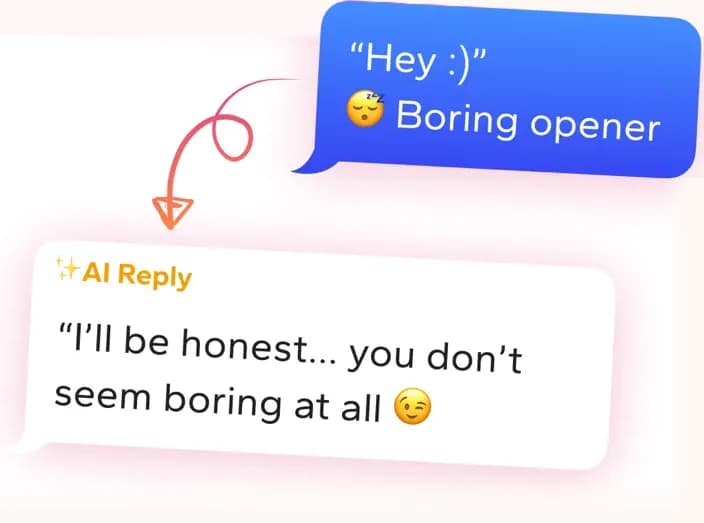
Get replies that sound like you
Screenshot the conversation in WingAI. It reads the vibe and gives you natural replies for this exact situation.
Try for freeRizz AI Screenshot the chat and get the next message for this person.
The difference between invested and controlling
A guy who's interested asks about your day. A guy who's obsessed needs proof of where you are and who you're with. One texts you twice a day. The other texts every hour and gets upset if you don't reply within minutes. One remembers things you've said and brings them up. One uses what you've told him as evidence that you're his or that you owe him something.
Obsession also shows up in intensity that came too fast. He said "I love you" on date three. He's already talking about your future together and getting defensive if you don't match his timeline. He positions himself as the only person who really understands you and gets uncomfortable when you mention friends or family. These patterns aren't about how much he cares. They're about control and fear disguised as attachment.
How to reply without encouraging the cycle
Your goal is to break the feedback loop. Right now he's learned that constant contact gets a reaction from you, even if that reaction is frustration. You need to stop rewarding the behavior with engagement.
Keep your reply short and boring. No explanation of where you were or why you didn't reply faster. No reassurance about how much he means to you. No apology for having a life. Instead, name what you see happening in one sentence and set one clear boundary. Then stop. Don't defend the boundary or explain why you need it. Let the boredom of your reply be the lesson. If he escalates trying to get a real conversation going, you stay consistent. Same short reply. Same boundary.
When to step back and what happens next
Send the boundary-setting reply once. If he responds by pushing back, asking why, or trying to turn it into a deeper conversation, do not engage further that day. Wait until tomorrow to respond if you do, and keep it just as short. Do not get pulled into defending your right to privacy or independence.
Watch what happens over the next week. If he respects the boundary and pulls back, the obsession was behavioral and responsive to limits. If he escalates, gets angry, or tries harder to control you, the obsession is about ownership. At that point, stop replying altogether. His reaction will tell you whether this is salvageable or whether you're dealing with someone who won't accept no.
Why these replies fail
“omg babe i'm so sorry i didn't reply faster! i was with my coworkers but i'm free now and thinking about you. you mean so much to me and i love that you care this much”
This teaches him the checking in worked and rewards the behavior with exactly what he wanted: reassurance and your full attention.
“why do you always need to know where i am? this is suffocating. i need space and you need to work on your insecurity”
It's honest but it opens a debate. He'll defend himself, you'll explain more, and the conversation becomes about his feelings instead of your boundary.
“*no reply, blocking him immediately*”
Without a clear message, he doesn't understand what he did or why you left, so he'll escalate with other people in his life or keep trying to contact you through new accounts.
Common mistakes
- Explaining your day in detail to ease his worry, which teaches him that checking in works
- Reassuring him with "I love that you care" when what's happening isn't care
- Going silent to create space, which he interprets as playing hard to get
- Having a long talk about his feelings, which centers his experience instead of your boundary
- Blocking or cutting him off suddenly without a clear message, leaving room for him to escalate
Questions people ask
- Is constant texting always obsession or could it just be his love language?
- Love languages are about how someone shows care once a relationship is established and mutual. Obsession is about need and control early on. If his constant contact happens before you've agreed you're together, if he gets upset when you don't match his pace, or if the messages are about monitoring you rather than connecting with you, it's obsession. Love language doesn't come with resentment.
- What if he gets angry after i set the boundary?
- Anger after you set a limit is a red flag. It means he views your boundary as rejection or betrayal rather than reasonable. Stay firm and don't engage with the anger. A short reply once is enough. If it continues, you have your answer about whether this person can handle boundaries. Stop replying. His anger is not your responsibility to manage.
- Should i tell him directly that his behavior is obsessive?
- Not in those words. Calling it obsession puts him in a defensive position and he'll debate whether he's obsessive or just in love. Instead, describe the specific behavior you need to stop. "I need you to stop asking where I am and who I'm with." That's concrete and harder to argue against than a label.
- Can obsessive behavior change or will he always be like this?
- It can change if he recognizes it and commits to working on it, which most people won't do without consequences. Your boundary might be the consequence that makes him see it. But you're not responsible for fixing him, and his willingness to change is not your job to test. Protect yourself first. If he changes, you'll see it over months, not days.
What people say after using WingAI
“I was skeptical at first. Then I tried it on a dry chat and the replies actually sounded like me, not a chatbot.”
Mazoonx
“I overthink every text. Having three options and picking the one that sounds like me cut that spiral short.”
Sam R.
“I'm busy and half the profiles give you almost nothing to work with. WingAI gets me a solid first line fast without me staring at the screen for ten minutes.”
Ralph
Get replies that sound like you
Screenshot the conversation in WingAI. It reads the vibe and gives you natural replies for this exact situation.
Try for free