She stopped sending good morning texts. Here's what changed.
She used to text good morning first and now only answers when you start things. Here is what the shift usually means and how to respond without chasing.
Those morning texts cost her something small but real. She had to think of you before the day pulled her elsewhere, and she chose to spend that moment on you. When they stop, the likeliest explanation is a change in how much attention she is willing to hand out, and the reasons vary a lot. A heavier workload, a bad stretch with family, a growing doubt about the two of you, or a new person in her orbit can all produce the same visible result. From your side of the screen they look identical, which is why guessing at motives usually goes nowhere.
What you are after is a reply that gives her an easy reason to start talking again, without asking her to explain herself. You are not trying to restore the old routine on demand. People rarely resume a habit because someone pointed out they dropped it. They resume it when contact feels light and rewarding again. So the goal is to become pleasant to hear from, not to extract proof that she still cares. Aim for a message that has something in it, a thought, a small story, a question tied to something only you two know.
Timing matters more here than people expect. A text sent at 7 a.m. in the style of her old morning messages reads like a request to bring the ritual back, and she may feel the pressure in it. Midday or evening, when the day has given you something to talk about, feels natural. Texting is also a medium where silence gets over-read. A few hours of quiet might mean she is in a meeting or asleep, not pulling away. Judge the pattern over a week or two, not over a single afternoon.
The things that backfire most are the ones that turn your hurt into her problem. Pointing out that the morning texts stopped hands her a charge to answer, and most people respond to a charge with defensiveness or vague reassurance. Sulky one-liners work the same way, and so does a rapid pile of follow-ups after a slow reply. Each of these tells her that contact with you now carries emotional upkeep, which is exactly the thing she may be trying to ration right now. Lighter is almost always better.
When she answers, read the shape of it, not just the fact of it. A reply that picks up your thread, adds a detail of her own, or tosses a question back means she has room for you. A reply that answers literally and stops, arrives hours later, or comes in single words means she is being polite while saving her energy. One lukewarm answer proves little. A run of them over several exchanges tells you where you stand, and you can decide how much of your own effort that deserves.
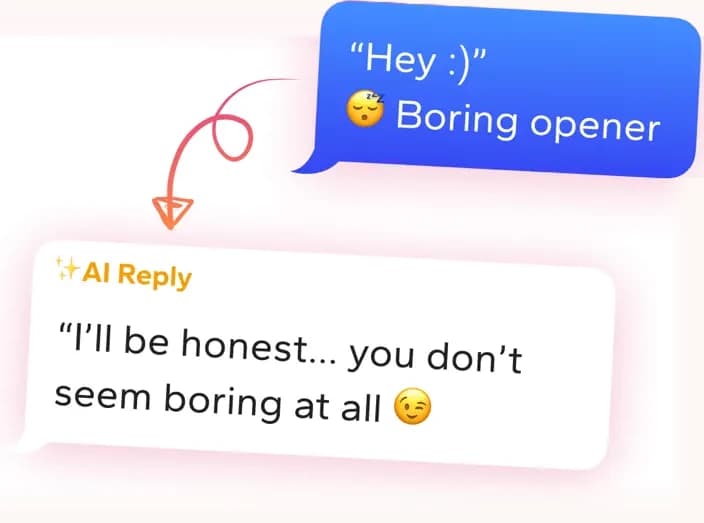
Get replies that sound like you
Screenshot the conversation in WingAI. It reads the vibe and gives you natural replies for this exact situation.
Try for freeWhy these replies fail
“Remember when you used to text me every morning? What happened?”
It turns her dropped habit into an accusation, so she has to defend herself instead of enjoying the conversation.
“Wow, you can reply in two minutes but can't start a conversation yourself.”
Pointing out that she only answers proves you are counting, and counting makes every future text from you feel like an audit.
“Good morning!! Thought I'd do the honors since you forgot :)”
Copying her old ritual and attaching blame to it forces a moment she may not feel, and the cheerful tone does not hide the scorekeeping.
Why the old routine ended quietly
Habits like morning texts rarely end with a decision. They fade because the person feels less pull or has less room, and nobody announces either. That is why asking about it tends to produce a fuzzy answer. She may not know herself whether she is busy, bored, or drifting. Look at what else changed around the same time. Is she slower to make plans, vaguer about the weekend, less curious about your day? If the texting is the only thing that shifted and she still shows up warmly in person or on calls, you are probably looking at a schedule or mood issue. If everything is cooler, take that seriously and stop trying to fix the texting in isolation.
Pick a topic only you two share
A reply earns attention when it could not have been sent to anyone else. Think of the running joke, the restaurant she wanted to try, the show you were both behind on, the story she told you last week that you kept thinking about. Bring that back with a small new angle, something that happened to you that connects to it. This gives her a low effort way to respond because the context already lives in her head. Avoid anything that needs a long explanation or a heavy emotional answer. You want her to feel a flicker of recognition, not a task.
Let one message do the work
After you send something with substance, the discipline is in what you do next, which is nothing. Do not check whether she read it, do not send a clarifying second text, and do not tell yourself she must be mad. Go do something that fills your evening. People can sense when a message is followed by hovering, and it changes how the message lands in hindsight. If she replies, match her energy and pace instead of doubling it. If a full week passes with no answer, take that as information about her availability and stop initiating. You can still be warm if she resurfaces, but you do not owe her a standing invitation.
Common mistakes
- Sending a message at 7 a.m. that mimics her old good morning texts, which reads as pressure to restart a ritual she dropped.
- Reading one slow or short reply as proof she is done, then reacting with a cold or sarcastic follow-up that damages a conversation that was fine.
- Piling on extra messages after a quiet day, which converts ordinary silence into a problem she now has to manage.
Questions people ask
- Why did she stop sending good morning texts but still reply to me?
- Usually her available energy or interest dropped, but she is not ready to cut contact. Replying costs little, while starting a conversation takes intent. It can also be plain busyness. Check whether other parts of how she treats you changed before reading it as a verdict.
- Should I stop sending good morning texts too?
- Yes, for now. Sending them into a one-sided pattern just highlights the gap. Shift to messages with real content at normal hours of the day. If she warms up and starts reaching out again, you can bring back small rituals, but let her restart them.
- Is it a bad sign that I am always the one texting first?
- It is a sign worth watching, not a verdict on its own. If it lasts weeks and her replies are short too, it points to low investment. If she is engaged when you talk and makes plans readily, the lopsided texting may just be how her stress shows up.
- How do I bring it up without sounding needy?
- Mostly you do not, at least not over text. A complaint about her texting rhythm tends to produce guilt, not warmth. If it still bothers you after a couple of weeks, say it once, calmly, in person or on a call, and frame it around what you enjoy, not what she failed to do.
What users say
“I overthink every text. Having three options and picking the one that sounds like me cut that spiral short.”
Sam R.
“I was skeptical at first. Then I tried it on a dry chat and the replies actually sounded like me, not a chatbot.”
Mazoonx
“Used it for a couple hours and set up a date the same night. Not even kidding.”
Nikola2214
Get replies that sound like you
Screenshot the conversation in WingAI. It reads the vibe and gives you natural replies for this exact situation.
Try for free