Complete list of Hinge prompts and how to answer them
A working list of Hinge prompts sorted by type, plus what each category is fishing for and how to answer so people actually message you back.
Hinge changes its prompt library over time, so no list stays complete for long, and any page claiming to hold every single one is out of date by the time you read it. What stays stable is the structure. The prompts fall into families, and each family invites a different kind of answer. Learn the families and you can handle a prompt you have never seen before, which is more useful than memorizing a catalogue.
Think about the person scrolling your profile. They are usually looking for one thing to grab onto, a detail concrete enough that a first message writes itself. A prompt answer is bait for that message. If your answer is a closed statement, there is nothing to pick up. If it contains a small loose thread, a place you mention, a mildly strange habit, a half-told story, then replying costs them almost no effort. That low effort is what you are designing for.
Timing and placement matter here. Hinge shows prompts as separate cards between your photos, so each answer gets read alone, usually in a few seconds, often one-handed on a commute. Long answers get skipped. Answers that need the previous card to make sense get misread. Pick prompts that sit in different categories so your profile does not read like one note played three times. A humor prompt, a story prompt and a values prompt together give a stranger three different doors into a conversation.
What tends to backfire is trying to sound like the best version of yourself instead of answering the question asked. Prompts about dealbreakers get turned into dating-app manifestos. Prompts about spontaneity get a vague claim of being adventurous. Humor prompts get a stack of jokes with no point of view. Readers have seen all of it. Another common failure is answering with an inside reference nobody can decode, which reads as a closed door rather than charm. And copying a famous answer you found online guarantees someone has seen it before.
Watch what comes back. If your matches keep quoting the same prompt in their openers, that card is working, and you can lean into that style on the others. If every opener ignores your prompts and talks about your photos, the answers are probably too generic or too long to register. A reply that echoes your words but adds nothing is a lukewarm response, while one that brings a story of their own means the prompt did its job. Let those patterns, not guesswork, decide which answers you keep.
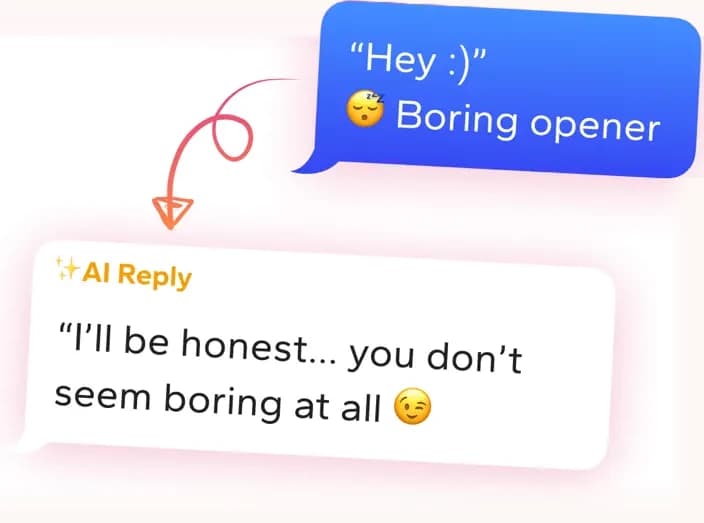
Get replies that sound like you
Screenshot the conversation in WingAI. It reads the vibe and gives you natural replies for this exact situation.
Try for freeHinge AI Screenshot the prompts and get a comment written for that profile.
Prompts that ask for a hot take
These are the opinion prompts: a take you will defend, a hill you will die on, a pet peeve, a controversial food opinion, the best way to spend a Sunday. They exist to find out whether you will commit. The best replies pick a narrow, slightly unexpected position and back it with one concrete detail, such as a specific restaurant order, a specific weekday ritual, or a specific object you refuse to part with. Broad takes about pineapple or morning people are so common they read as filler. Keep the stakes low and the tone amused. A hot take that sounds bitter or superior makes the reader feel judged before they have even matched with you.
Prompts that ask for a story
Story prompts include the most spontaneous thing you have done, a favorite travel moment, a time you were embarrassed, and the first thing you would do with a free day. They reward specificity more than any other category. Name the place, the weather, what went wrong, who was there. Then stop before the ending so the other person has a reason to ask. A tidy story with a moral leaves nothing to follow up on. A story that stops at the funniest or strangest moment practically hands over the opening line. Skip anything that needs three sentences of setup, because readers will not stay for it.
Prompts that ask what you value
Values prompts cover dealbreakers, what you are looking for, a life lesson, what you are most grateful for, and what you want someone to know about you. They are the easiest to answer badly because the pull toward sounding impressive is strong. Choose one real thing and describe a small moment that shows it instead of naming the trait. Gratitude for a friend who drove four hours to help you move says more than a sentence about loyalty. Keep dealbreakers to a single honest one, stated plainly, without a list of ten ways someone could disappoint you. The tone should be warm and settled, not defensive.
Messages that backfire
“Looking for someone who can keep up with my energy and doesn't play games.”
On a prompt about what you want, this describes a type of person instead of giving the reader anything about you to respond to.
“My most spontaneous thing was a trip once. It was really fun and I would do it again.”
A story prompt needs a place, a mishap or a detail, and this offers none, so there is no thread for anyone to ask about.
“Unpopular opinion: people who put pineapple on pizza are what's wrong with society. Fight me.”
A hot take prompt rewards playful commitment, but this one sounds combative and recycles a joke so common it reads as filler.
Where people go wrong
- Choosing three prompts from the same family, so the profile reads as one repeated note instead of showing different sides of you.
- Writing an answer that depends on context from another card or an inside joke, which a stranger scrolling quickly cannot decode.
- Using the values prompts to list requirements for a partner instead of describing something about your own life.
Common questions
- Is there a complete list of all Hinge prompts?
- Not a permanent one. Hinge adds, retires and reorders prompts regularly, so any fixed list goes stale. The prompts fall into stable families: opinions, stories, values, and playful or quirky ones. Learn how each family works and you can answer any prompt you see, including new ones.
- How many prompts do I need to answer on Hinge?
- Hinge asks for three, and three is plenty. Pick prompts from different families so your profile covers humor, a story and something you care about. Weak extra answers dilute strong ones, so fill the required slots well rather than adding more.
- Which Hinge prompts get the most replies?
- Story and opinion prompts tend to give people the easiest opening because they contain a detail to ask about. Prompts answered with something specific beat prompts answered with a generic line, whatever the prompt. Check which of your cards your matches quote in their openers and keep that style.
- Should I reuse a funny Hinge prompt answer I found online?
- Avoid it. Popular answers have already been seen by many of the people you will match with, and they read as borrowed. Use the format as a guide, a small concrete detail with a light tone, but write the content from your own life.
From our users
“I was skeptical at first. Then I tried it on a dry chat and the replies actually sounded like me, not a chatbot.”
Mazoonx
“I overthink every text. Having three options and picking the one that sounds like me cut that spiral short.”
Sam R.
“I'm busy and half the profiles give you almost nothing to work with. WingAI gets me a solid first line fast without me staring at the screen for ten minutes.”
Ralph
Get replies that sound like you
Screenshot the conversation in WingAI. It reads the vibe and gives you natural replies for this exact situation.
Try for free