Tell him his tone felt dismissive when you set a boundary
How to call out a defensive or cold reaction to your boundaries without escalating or backing down.
When you state a boundary and his response feels harsh, dismissive, or irritated, you're picking up on tone. That tone matters more than the words. It signals whether he respects what you just said or resents you for saying it.
Calling this out directly is hard because you risk looking oversensitive or starting a fight. But silence means he thinks that tone was okay. A good reply names what happened, stays factual, and gives him one clear chance to reset.
The goal is not to convince him your boundary was right. It's to show him that how he responded to it was not acceptable, and that you need to see a different approach moving forward.
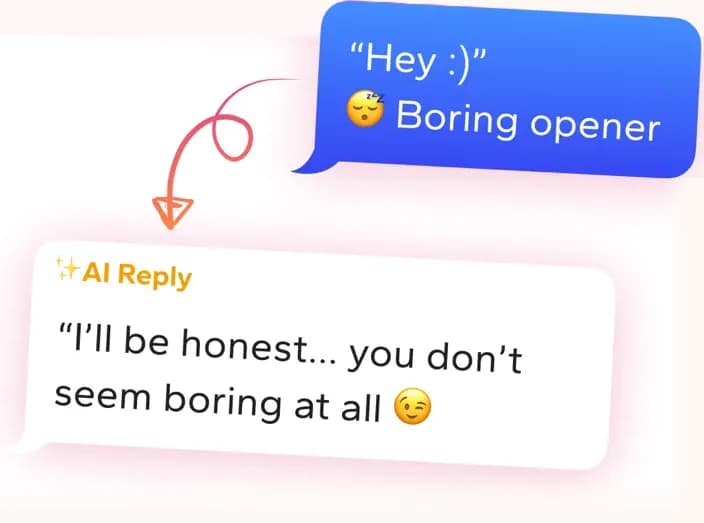
Get replies that sound like you
Screenshot the conversation in WingAI. It reads the vibe and gives you natural replies for this exact situation.
Try for freeRizz AI Screenshot the chat and get the next message for this person.
A short answer that suddenly changes tone
When someone's tone shifts the moment you set a boundary, they're showing you something. They might be defensive about losing control. They might resent that you have needs outside the relationship. They might think boundaries are attacks. Whatever it is, that reaction is data.
He may not even realize his tone changed. Some people go cold automatically when they feel pushed back on. Others get irritated because boundaries feel like rejection to them. The point is not to guess his motivation. Just name what happened and watch what he does next.
State the tone, then pause for him to respond
A good move here has two parts. First, you describe exactly what you noticed. Not 'you were mean' but 'your voice got quiet' or 'you stopped responding' or 'you seemed frustrated with me.' Be specific enough that he can't deny it happened.
Then you name what the tone communicated to you: that he didn't want to hear this, or that he was unhappy with you for bringing it up. Don't soften it. Don't say 'maybe' or 'it felt like.' Say it like a fact. Then stop talking. His move is next.
Send it soon, but not in the heat
Wait until you're calm enough to write it clearly, but don't let days pass. If you bring this up a week later, it looks like you've been stewing and building a case. Bring it up within 24 hours while it's still the thing between you.
If he doesn't engage with it, or dismisses you, that tells you something important about whether he's willing to hear you. A man who respects your boundaries will feel bad, explain himself, or ask what he did. A man who doesn't will argue about your tone instead of his.
Why these replies fail
“I'm sorry for bringing that up yesterday. I know it was bad timing and I should've handled it differently.”
You're apologizing for your boundary instead of addressing his reaction to it, which teaches him that pushback on his tone gets him a concession.
“You were literally so rude to me when I mentioned my boundary. This is exactly like the time you ignored me for three days after I said no to your plan.”
Piling on old grievances dilutes the point and makes him defensive about being ganged up on instead of hearing what just happened.
“Maybe I'm being too sensitive, but it felt like you didn't want to hear what I was saying? I could be wrong though.”
Hedging your observation gives him an out and positions your legitimate concern as something fragile he can dismiss easily.
Common mistakes
- Apologizing for the boundary itself instead of addressing his tone
- Using soft language like 'maybe you didn't mean to' that lets him off the hook
- Listing his past mistakes to prove the pattern instead of focusing on this one moment
- Waiting too long to say something, then bringing it up in a heated moment
- Framing it as a question ('Did you get annoyed?') instead of a statement of what you observed
Questions people ask
- What if he says I'm reading too much into it?
- Stick with what you observed, not his intent. 'I'm not guessing what you meant. I'm telling you what I heard. Your voice changed and I felt shut down.' You're not asking him to agree with your interpretation. You're reporting the effect it had.
- Should I bring this up in person or text?
- Text is actually better here. It gives you both time to be clear without his immediate defensiveness interrupting. In person, he can shut you down with silence or a sarcastic comment before you finish. Text forces him to actually process what you said.
- What do I do if he apologizes but his tone doesn't change next time?
- That's a pattern. Words don't matter if the behavior doesn't shift. At that point you're not calling out a misunderstanding, you're seeing who he is. Consider whether this is someone who can actually adjust when you tell him something is wrong.
- Am I being too harsh by bringing this up at all?
- No. If you let someone react poorly to your boundaries without comment, you've just told him it's fine to do that. Boundaries need follow-through. Calling out his tone is the boundary working.
What people say after using WingAI
“I was skeptical at first. Then I tried it on a dry chat and the replies actually sounded like me, not a chatbot.”
Mazoonx
“I overthink every text. Having three options and picking the one that sounds like me cut that spiral short.”
Sam R.
“Used it for a couple hours and set up a date the same night. Not even kidding.”
Nikola2214
Get replies that sound like you
Screenshot the conversation in WingAI. It reads the vibe and gives you natural replies for this exact situation.
Try for free