How to tell her you're falling for her in Spanish
Say you're falling for her in Spanish without sounding rehearsed. What the phrases mean, how intense each one is, and how to read her reaction.
Hearing this in Spanish lands differently for her than hearing it in English, and what she feels depends on her relationship with the language. If Spanish is her first language, it may be the one she dreams in, argues in, and says goodnight to her mother in. A declaration in that language can feel intimate in a way English never reaches. It can also feel like a lot, because Spanish has stepped tiers of affection, and she will notice which one you picked. If she grew up in English and Spanish is her family's language, your effort can touch something tender. It can also feel like you are performing a version of her you imagined.
Your goal is to let her know where you are, in words that fit the real size of what you feel. Me estoy enamorando de ti describes motion: you are on the way to love, not arrived. That is precisely why it works for early and middle stages. Te quiero is sturdier and more settled, and te amo is reserved in many Spanish-speaking families for serious, long commitments. Choosing the phrase is the main decision. Borrowing a bigger one than you feel to impress her creates a debt you will have to pay later.
Timing and setting change everything. A voice or video call gives her your tone and your face, which matters because Spanish leans on warmth and rhythm more than on the words alone. A text strips that out, and any small grammar slip in writing looks permanent and gets scrutinized. In person is better still, since you can stop if her expression tells you the moment is wrong. Choose a quiet stretch, not the minute before she walks into a party or after a long day.
Things backfire in predictable ways. Pairing the declaration with a request, such as asking whether she feels the same, turns a gift into a quiz. Piling on superlatives, the I-can't-live-without-you register, sounds like a telenovela script and makes her worry about the pressure she is stepping into. Hedging with maybe or I think makes it sound like you are testing the water. And apologizing in advance for your feelings tells her they are a burden. Say it plainly, once, and let it sit.
Reading her reply takes patience. A smile and a quiet thank you can mean she is moved and still catching up to her own feelings. An immediate matching phrase means she was already there. Changing the subject quickly may mean overwhelm, not rejection, so watch what she does over the following days. If she keeps initiating plans, stays warm, and treats you the same or closer, you were heard. If she grows distant and answers in shorter bursts, she is telling you something without words, and you should believe it.
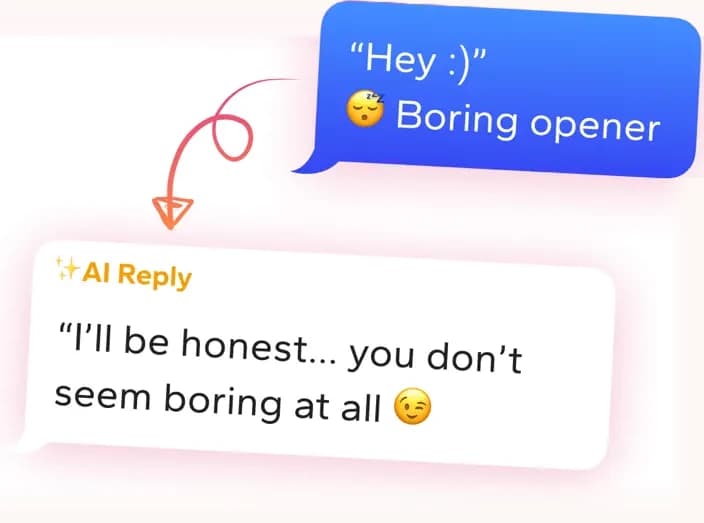
Get replies that sound like you
Screenshot the conversation in WingAI. It reads the vibe and gives you natural replies for this exact situation.
Try for freeWhy these replies fail
“Te amo con todo mi corazon y no puedo vivir sin ti, dime que tu tambien me amas”
Te amo is the heaviest phrase in Spanish, and pairing it with a demand for her to say it back leaves her cornered instead of cared for.
“Creo que tal vez me estoy enamorando de ti? No se, que piensas tu?”
The hedging and the closing question make it sound like you are testing whether she will reciprocate before you commit to your own feeling.
“Me estoy enamorando de ti pero no te preocupes, no quiero complicar las cosas”
Apologizing for your feelings in the same breath tells her they are a problem she has to manage, which spoils the warmth of what you just said.
Choosing the right level of intensity
Spanish gives you a ladder, and each rung means something different. Me gustas mucho is warm and light, fine for the first weeks. Me estoy enamorando de ti says love is forming and you know it. Te quiero is settled affection, used for partners and also for family and close friends, which is why it feels safer. Te amo is the heaviest, and many native speakers save it for deep commitment. Match the rung to what you actually feel after the time you have really spent together. If you have seen her four or five times, the second rung is already bold. Jumping up to impress her backfires, because she hears the gap between your words and your history.
Pronunciation and grammar worth getting right
A single slipped word can change the meaning, so rehearse out loud. Enamorarse takes de before the person, so it is enamorando de ti, never enamorando a ti. If you are speaking to a woman, remember that she would say estoy enamorada, while you say enamorado, and mixing these up is a common stumble for learners. Roll nothing you cannot roll, and do not force a regional accent you do not have. Short and slow beats long and ornate. If you trip, laugh and say it again. Most Spanish speakers find a clumsy sincere attempt far more moving than a polished sentence copied from a list.
Reading her reply, or her silence
People answer big feelings in very different ways, and a quiet reaction is not a verdict. Some freeze because they care and need a night to think. Others respond fast because they were waiting. Pay attention to the next few days instead of the first ten seconds. Does she reach out first, keep the usual warmth, and mention things coming up? That is a good sign. Does she become formal, slow to answer, and vague about plans? That is also an answer. Resist the urge to ask what she meant by her reaction. If she wants to talk about it she will, and pressing makes a gentle no into an uncomfortable one.
Common mistakes
- Picking te amo because it sounds more romantic, when the relationship is only weeks old and the phrase carries real weight in Spanish.
- Sending the declaration as a text with a typo in it, so that a grammar slip becomes the thing she remembers instead of what you meant.
- Reading a quiet reaction as rejection and following up the same night, instead of giving her a couple of days to absorb it.
Questions people ask
- What does me estoy enamorando de ti mean in English?
- It means I'm falling in love with you. The estoy plus a verb ending in ando describes something in progress, so it says love is growing, not complete. It is the most natural way to tell someone in Spanish that your feelings are deepening without claiming full love yet.
- What is the difference between te quiero and te amo?
- Te quiero is warm, settled affection used for partners, family, and close friends. Te amo is heavier and often saved for deep, committed romantic love. For someone you are falling for, te quiero or me estoy enamorando de ti usually fits better. Te amo too early can feel overwhelming.
- Should I say it in Spanish if I'm still learning?
- Yes, if you can say the one sentence smoothly and she knows you are learning. Practice it aloud until it feels natural. A simple, slightly imperfect attempt is usually touching. Skip it if you would be too nervous to focus on her instead of your pronunciation.
- How do I say it differently if she is a woman?
- You say me estoy enamorando de ti, which is the same regardless of who you address. The ending changes only when describing yourself. A woman says estoy enamorada de ti, a man says estoy enamorado de ti. Getting that ending wrong is a common learner slip.
What users say
“I was skeptical at first. Then I tried it on a dry chat and the replies actually sounded like me, not a chatbot.”
Mazoonx
“I overthink every text. Having three options and picking the one that sounds like me cut that spiral short.”
Sam R.
“I'm busy and half the profiles give you almost nothing to work with. WingAI gets me a solid first line fast without me staring at the screen for ten minutes.”
Ralph
“I always freeze on the first sentence. This gets me past that blank box so I actually hit send.”
joejoe4567
Get replies that sound like you
Screenshot the conversation in WingAI. It reads the vibe and gives you natural replies for this exact situation.
Try for free