How to Reply When She Says She Doesn't Trust Online Profiles Anymore
She's said she doesn't trust online profiles. Here's how to read that, what a good reply has to do, and how to follow up without getting defensive.
When someone says she doesn't really trust online profiles anymore, she is usually not talking about you specifically. She has probably been burned by a catfish, a profile that looked nothing like the person, or a match who turned out to be married or just performing. Often she's testing whether you'll get defensive or whether you'll treat the concern as reasonable. Both reactions tell her something about you.
What a good reply does is accept the concern as fair without apologizing for your whole profile and without flooding her with proof. You want her to feel that you understand why she's wary and that you're not going to make her feel silly for having the instinct. The reply also has to give her a reason to keep talking, which usually means answering her concern briefly and then giving her something real to react to.
The mistake most people make is treating the comment as an objection to overcome. Once you do that, every line you send sounds like a sales pitch. Treat it as information about what she's worried about, and let the conversation move from there.
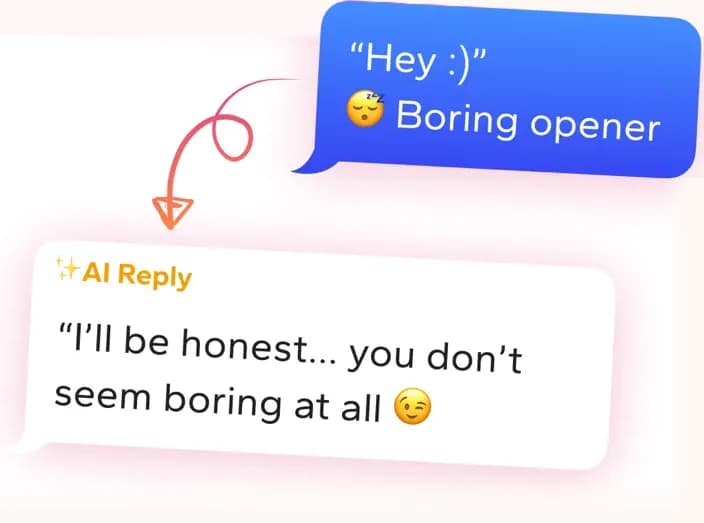
Get replies that sound like you
Screenshot the conversation in WingAI. It reads the vibe and gives you natural replies for this exact situation.
Try for freeRizz AI Screenshot the chat and get the next message for this person.
Read what the comment is pointing at
A line like this usually comes after a specific bad experience, even if she never describes it. Look at what she's said around it. If she mentions photos, she's probably been shown old or heavily edited pictures. If she mentions people being fake, she may have had a match who disappeared or who was clearly catfishing. If she sends it flatly with no question attached, she may be closing a door politely while keeping the conversation open.
Your job is to figure out whether this is a passing comment or a real hesitation she wants addressed. A passing comment gets acknowledged in a line and the chat moves on. A real hesitation needs you to show, in a small and unforced way, that you're the kind of person whose profile matches who's typing. Notice whether she's asking you anything directly. If she isn't, don't invent a question for her to answer about trust.
Let your profile do the proving
The strongest thing you have here is evidence that doesn't require you to argue. Specific details from your life that match your profile are better than any statement about being honest. If your photos show you climbing somewhere, mention a detail about that trip that a stranger couldn't know. If your bio says you run a bakery on weekends, talk about a specific frustration from the last batch rather than insisting you do.
The reply needs to hit two jobs. First, show you took the comment seriously in a sentence or two. Second, hand her a concrete, checkable thread that she can pull on if she wants. Keep the acknowledgement short. The longer it runs, the more it sounds like you're worried she'll leave. Then give her something specific enough that it could only come from you, and leave room for her to respond to it rather than to your credibility.
Wait a day, then offer something light
Send the reply in the normal rhythm of your conversation. If she usually answers within an hour, don't rush this one into the middle of the night or reply within seconds as if you've been waiting. A reply sent during a normal part of the day reads as calm. Sending it while you're obviously anxious reads as needing reassurance.
If she doesn't answer within a day or two, don't follow up with another reassurance about being real. That makes the whole thing about your credibility again. A single light message on a different topic is enough, something that gives her an easy way back in without mentioning trust. If that also gets nothing after about a week, let it go. Someone who has decided online profiles aren't worth her time has given you a clear answer, and chasing her will only confirm the worry she came in with.
Why these replies fail
“I totally get that, but I promise I'm really not a catfish. I can send you more pictures or we can do a quick video call tonight if you want to see for yourself.”
It turns her concern into a request for proof and pushes a call before she's had a chance to feel comfortable, which tends to make people more wary.
“Haha well you're clearly very cynical, but I'm 100% legit. So what's your favourite pizza topping?”
It dismisses her concern as cynicism and then drops the subject without acknowledging it, so she's left feeling like her comment didn't count.
“That's so fair, I've been on the apps forever and I know exactly how frustrating it is. Honestly I was so disappointed by a few matches too. Anyway, have you been hiking lately?”
It sympathizes at length while sharing a vague story about your own disappointment, which makes the moment about your experience and then changes topic too quickly.
Common mistakes
- Apologizing for your profile or saying you understand completely, then going quiet on the actual topic
- Sending a long defence listing why your photos are accurate and how many people have met you
- Offering to video call immediately as if that solves everything, which can feel like pressure
- Ignoring the comment and pivoting straight back to your own questions
- Getting playful about her being cynical before you've acknowledged the concern at all
Questions people ask
- Does 'I don't trust online profiles' mean she's not interested in me?
- Not necessarily. It usually means she's been let down before and is being careful. It can still mean she's losing interest, but on its own it's a caution rather than a rejection. Look at whether she's still replying with warmth and asking you things. If she is, the comment is more likely about her past than about you.
- Should I send a photo to prove my profile is real?
- Not as your first move. Sending a photo on demand can feel like you're meeting a test you didn't agree to. A better approach is to mention a specific detail from the photo or your life that matches what she's seen, and let her decide whether to look more closely. If she asks for something specific, you can respond then.
- Is it okay to suggest a video call to ease her mind?
- It can work, but timing matters. Suggesting a video call very early, right after she's voiced distrust, can feel like pressure. If you've been chatting for a while and it comes up naturally, it can reassure her. Frame it as wanting to talk more rather than as proof, so the call feels like a next step and not an exam.
- What if she says she's been catfished before?
- Take it seriously and don't make it a joke. You can acknowledge that it sounds like a rough experience and that you understand why she's careful. Don't ask for details she hasn't offered, and don't compare it to your own dating history. Keep the focus on the two of you, and let her decide how much she wants to share.
What people say after using WingAI
“My openers used to be boring. Now I reference something from her profile and people actually write back.”
Aiden K.
“I overthink every text. Having three options and picking the one that sounds like me cut that spiral short.”
Sam R.
“I was skeptical at first. Then I tried it on a dry chat and the replies actually sounded like me, not a chatbot.”
Mazoonx
Get replies that sound like you
Screenshot the conversation in WingAI. It reads the vibe and gives you natural replies for this exact situation.
Try for free