How to respond when she asks about your past relationships
Learn how to answer questions about exes without oversharing, sounding bitter, or dodging the question. Smart replies that build trust.
When she asks about your previous relationships, she's testing two things: whether you can talk about real stuff without defensiveness, and what your patterns actually are. This is a trust checkpoint. A bad answer makes you look either guarded, still hung up, or like you didn't learn anything from past breakups.
A good reply shows you can be honest without turning it into therapy, that you left things on decent terms or at least understand what went wrong, and that you're not carrying baggage into whatever you two might build. You don't need to give a full history. You need to show self-awareness and move the conversation forward.
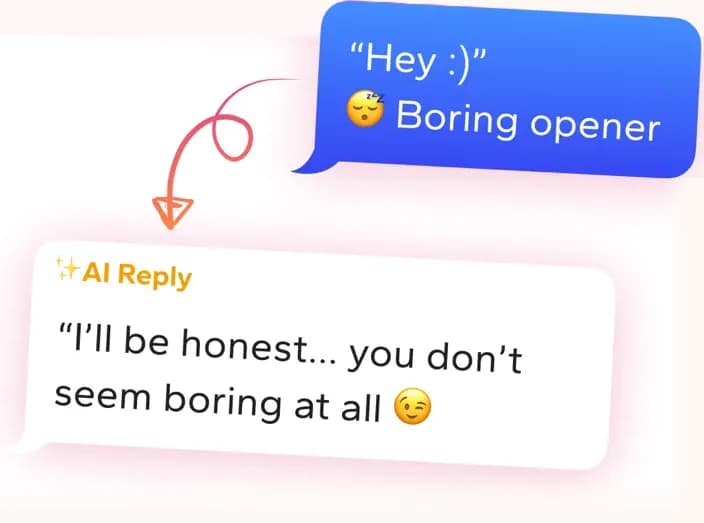
Get replies that sound like you
Screenshot the conversation in WingAI. It reads the vibe and gives you natural replies for this exact situation.
Try for freeRizz AI Screenshot the chat and get the next message for this person.
What she's really checking when she asks
She's not looking for a catalog of your exes. She wants to know if you can talk about hard things without blaming everyone else, and if you're actually over it. A question about your past is often a question about your future with her. Can you handle conflict? Do you learn from mistakes? Are you still tangled up in old drama?
She's also listening for red flags. If you trash every ex, that's a problem. If you won't say anything real, that's a problem too. Somewhere between total silence and total oversharing is where you want to be. You can name what happened, what you learned, and why it matters now.
Keep it short, honest, and forward-looking
Your reply does three things. First, it answers the actual question without the rundown of every detail. Second, it shows you understand what you contributed to the ending, not just what went wrong. Third, it signals you're not dragging that relationship into this one.
Don't volunteer a ten-minute backstory. Give her the shape of it: how long it lasted, a real reason it ended, and one thing you learned. Then bring it back to the present. The goal is to show maturity and openness, not to unload.
The timing of follow-up matters more than you think
Send your reply the same day if possible. If you wait three days to answer a direct question, she notices. It signals you're uncomfortable or dodging.
If she doesn't follow up after you answer, that's fine. She got what she needed. Don't keep talking about your ex to fill the silence. If she asks follow-ups, answer them straight. If the conversation dies, move to something new. If she brings it up again weeks later in a different context, that usually means she's still checking something. Answer again, stay consistent, and don't get defensive about repeating yourself.
Why these replies fail
“Lol honestly I don't really like to talk about that stuff. Let's focus on us instead!”
Dodging a direct question makes you look like you're hiding something or can't handle real conversation.
“She was insane, literally the most toxic person I've ever met. My friends all told me to leave her years before I did. Total nightmare.”
Blaming everything on her and calling her insane makes you sound immature and tells her that exes always get villainized by you.
“We were together for 3 years. She wanted to move to Portland, I didn't, so we broke up. Honestly it's still pretty fresh and I think about her a lot.”
Admitting you think about an ex a lot signals you're not over it, which makes her feel like she's a second choice.
Common mistakes
- Giving a five-minute villain origin story about an ex and why she was awful
- Staying vague and deflecting with humor every time the topic comes up
- Oversharing relationship details that make her uncomfortable or feel like she's hearing gossip
- Acting like all your exes were crazy or at fault, never acknowledging your own role
- Saying 'I don't like talking about this' and closing off when she's trying to get to know you
Questions people ask
- Should I tell her the detailed story of what my ex did wrong?
- No. Give her the facts and your role in it. If she wants details, she'll ask. Unprompted venting about an ex reads as either bitter or hung up. Keep the initial answer to two or three sentences.
- What if I'm still in contact with an ex? Should I mention that?
- Yes, but frame it right. If you're actually platonic, say so briefly. If there's still tension or you're not totally sure about boundaries, this is not the moment to volunteer that. She'll probably ask directly if it matters to her.
- How do I answer if the breakup was messy or I was the one who ended it badly?
- Own it. Say what happened, name what you did wrong, and say what you'd do differently now. That honesty is worth more than a sanitized version. She respects someone who can admit mistakes.
- What if I have a lot of exes or a complicated dating history?
- Don't list them all. Talk about the most recent or most serious relationship. If she wants to know about the pattern, she'll ask. One honest answer beats a defensive rundown of your entire romantic timeline.
What people say after using WingAI
“I was skeptical at first. Then I tried it on a dry chat and the replies actually sounded like me, not a chatbot.”
Mazoonx
“I overthink every text. Having three options and picking the one that sounds like me cut that spiral short.”
Sam R.
“Used it for a couple hours and set up a date the same night. Not even kidding.”
Nikola2214
Get replies that sound like you
Screenshot the conversation in WingAI. It reads the vibe and gives you natural replies for this exact situation.
Try for free