How to respond when a girl calls you daddy
She texted you 'daddy' and you're staring at the screen. Here's how to read her intent, set your tone, and write a reply that fits the conversation you're alrea
A text like this usually lands out of nowhere, and the person sending it often knows that. She may have typed it half as a dare to herself. Maybe the chat had been warming up, maybe she was riding a joke you both made, maybe she wanted to see whether the conversation could survive a little heat. Whatever the reason, she has put something slightly exposed on the table, and the next few seconds of your reply decide whether she feels bold or embarrassed.
Your aim is simple to state and harder to do. You want her to feel the joke was welcome, and you want the thread to keep moving without a lecture on what the word means to either of you. That means acknowledging it with a light touch and then letting the exchange breathe. Think of the tone you would use if a friend teased you about something at a party. You smile, you toss something back, and nobody stops the music to discuss it.
Timing and medium matter more than people expect. Over text, she cannot hear your laugh or see your face, so a reply that is too flat reads as cold and one that is too eager reads as a pounce. If the message came late at night, the energy may be looser and a little more teasing than it would be at noon. If it came in the middle of a work-hour exchange, she may be testing how you handle the unexpected. Match the hour and the pace she set. A quick, relaxed answer fits better than a carefully composed one that arrives after twenty minutes of visible silence.
Most replies go wrong in one of two directions. Some people recoil, going formal or asking what she means, which turns her playful moment into an interrogation. Others lunge, piling on explicit follow-ups before they know how she feels, which makes her regret being bold. A third failure is the long, self-conscious reply that explains why you are fine with it. Explaining is a way of showing you were rattled. Keep what you send short, a little amused, and anchored in something specific from your conversation so it sounds like you rather than a script.
What she sends next tells you where to go. If she answers with laughter or a teasing jab, the door is open and you can keep the banter going, raising the heat only as far as she does. If she goes quiet or changes the subject, she has probably said what she wanted to say and does not need it extended. If she doubles down, she is giving you a clear green light, but you can still pace yourself. Follow her lead for a message or two before you decide how far you want to take it.
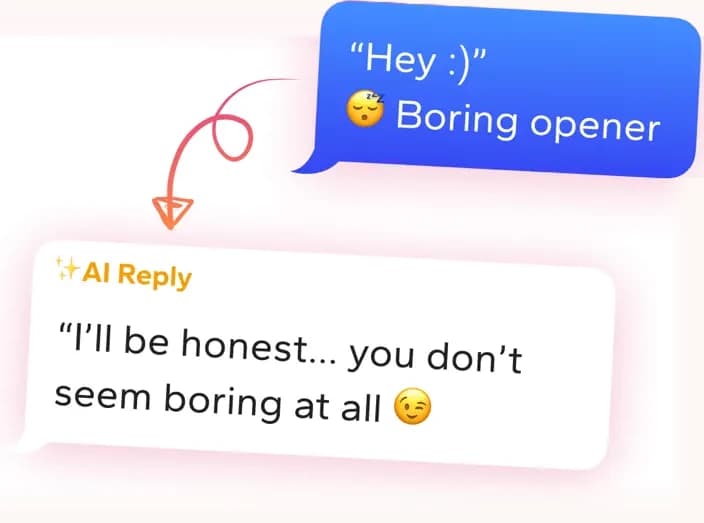
Get replies that sound like you
Screenshot the conversation in WingAI. It reads the vibe and gives you natural replies for this exact situation.
Try for freeReading the context before you reply
The same word carries different weight depending on what came before it. If the two of you have traded jokes for days, she is most likely continuing a bit. If you matched on a dating app yesterday, she is making a bolder move and may be nervous about how it lands. If you have known each other for years, it might be an inside joke or a deliberate step toward something new. Scroll up before you answer. Look at her punctuation, her emoji, and whether she followed it with a laughing reaction or left it hanging. A message sent alone with no softener is usually a deliberate test. A message wrapped in jokes is usually lighter. Your reply should fit the version she actually sent, not the worst or best case you imagined.
Choosing a tone that fits you
You have a few reasonable angles. One is a playful tease that turns the word back on her, the way you would rib a friend who said something cheeky. Another is a dry, deadpan acknowledgment that treats the whole thing as perfectly normal and moves on, which can be funny precisely because you refuse to make a fuss. A third is a light callback to something she told you earlier, tying the moment to a shared reference so the reply feels specific. Pick the one that sounds like how you already talk to her. If you are usually sarcastic, stay sarcastic. A sudden new personality in one message is easy to spot and slightly off-putting.
Handling it when it's not your thing
Maybe the word makes you uneasy, or you simply do not feel that kind of spark with her. You are allowed to opt out, and you can do it without humiliating her. Keep the acknowledgment brief and friendly, then redirect to something concrete, like a plan, a story, or a question about her day. Do not lecture, do not announce that you are uncomfortable in a way that makes her apologize, and do not go cold for the next hour as a punishment. If she pushes the theme again after you have steered away, a calm, clear sentence saying it is not your style is fine. Say it kindly and say it once.
People also ask
- What do I say when a girl texts me daddy?
- Keep it short, relaxed, and in the same tone she used. A playful tease, a dry acknowledgment, or a callback to something from your earlier conversation all work. Avoid explaining yourself or asking what she means. Your goal is to show you can take a joke and keep talking.
- Does she calling me daddy mean she likes me?
- It usually means she feels comfortable enough to be bold and a bit flirty with you. That is encouraging, but it is not a promise of romantic interest. Watch how she behaves across the next few messages, such as whether she keeps flirting, asks you questions, or makes plans.
- What if I don't like being called that?
- You can decline without making a scene. Acknowledge the message in a friendly, low-key way and move the chat to another topic. If she keeps going and it bothers you, tell her plainly and kindly that it is not your thing. Most people will back off.
- Should I reply right away or wait?
- Reply when you naturally would. A reasonable gap is fine, and an instant answer is not required. What matters is that you do not hover for hours and then send something over-polished. If you are late, send it casually without apologizing or compensating with extra jokes.
Why these don't work
“Um, that's a little forward, don't you think?”
She took a small social risk and you answered with a reprimand, which makes her feel judged and teaches her not to be playful with you again.
“Haha okay I see what you're doing. Anyway, what are you up to this weekend?”
Naming her move and then swerving instantly shows you noticed it, felt flustered, and wanted out, which reads as discomfort rather than ease.
“Wow, I like where your head's at. Tell me more about that.”
She was testing the water with one word, and pushing for explicit detail turns a light moment into pressure before she has shown she wants that.
Pitfalls to avoid
- Asking her what she means or why she said it, which turns a light moment into a question she now has to defend.
- Writing a long, carefully built reply that explains your comfort level, since length itself shows you are thinking harder than the joke deserved.
- Escalating to explicit territory in your first answer before she has given you any sign she wants to go there.
It doesn't sound like a bot
“I overthink every text. Having three options and picking the one that sounds like me cut that spiral short.”
Sam R.
“She went cold mid-week and I had no idea what to say. The reply I sent felt natural and she picked the chat back up.”
Marcus T.
“I was skeptical at first. Then I tried it on a dry chat and the replies actually sounded like me, not a chatbot.”
Mazoonx
Get replies that sound like you
Screenshot the conversation in WingAI. It reads the vibe and gives you natural replies for this exact situation.
Try for free