How to Reply When She Says She's Been Burned Before
She's said she's been hurt and is cautious about dating. Here's how to read it and reply so she feels safe enough to keep talking.
When someone tells you they've been burned before and they're cautious, they're usually not saying no. They're telling you how fast they're willing to move and how much they're going to test you before they relax. The mistake most people make is treating it as a problem to fix, either by reassuring her too hard or by pulling back and getting awkward about it.
A good reply does three things. It acknowledges the thing she shared without making it a big moment, it shows you're not going to push for more than she's offering, and it keeps the conversation moving in a light direction. You want her to finish the exchange feeling like she said something real and nothing bad happened.
You also need to accept that caution often shows up as slower replies, shorter answers, and testing questions. Those aren't rejections. They're her checking whether you're steady.
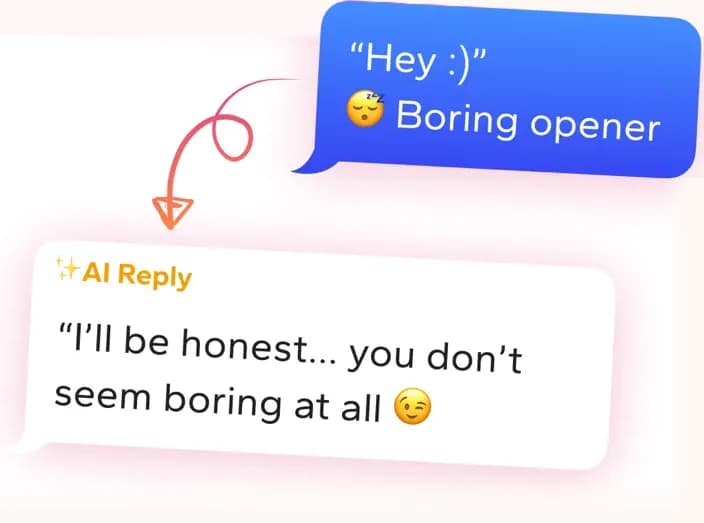
Get replies that sound like you
Screenshot the conversation in WingAI. It reads the vibe and gives you natural replies for this exact situation.
Try for freeRizz AI Screenshot the chat and get the next message for this person.
Read the pace, not the wound
When she says she's been burned, she is usually telling you about her speed and her threshold, not handing you her history. The phrase "I'm a bit slow with this stuff" is a request: keep things unhurried and don't read silence as a rejection. Look at how she has been engaging up to now. Are her replies warm but brief, or is she asking you questions back? If she's still asking things, she's interested and protecting herself at the same time. If she has gone flat, that's a different signal, and you should answer shorter and let her set the rhythm.
Don't try to figure out the details of what happened to her. She will share more if and when she wants to, and a question about it tells her you're looking for a story rather than a person. Treat the disclosure as a boundary she's drawn, and respect it by staying in the present and being easy to talk to.
Answer before you get curious
Your reply needs to receive what she said in one sentence, then move on. A short, unfussy acknowledgement tells her you heard her and that it doesn't change how you see her. Then give her something to respond to that isn't about the past, like a question about her week, a shared joke, or a light opinion on something you're both looking at. The conversation should feel like it's going forward at a comfortable speed.
Keep your own energy steady. If your message is noticeably more intense than hers, she will read that as pressure. Match her length and warmth, or go slightly lower. You are showing her that slow is fine with you, and that you're not going to make her manage your expectations on top of her own.
The week of silence matters more than the text
Cautious people often go quiet for a day or two after they've shared something personal, because they're deciding whether they regret saying it. A gap of a day or two after her disclosure doesn't mean the reply failed. Don't follow up in that window with anything heavier. If you send a second message before she has had time to come back, you turn her private reflection into a conversation you have to answer for.
If the silence stretches beyond about a week with no reply from her, send one short, low-stakes message that doesn't reference the earlier conversation. Something like a link, a question about a shared interest, or a simple check-in works. If that also gets nothing, stop. Continuing past that point signals that you need her reply more than she wants to give one, and that's the thing that makes cautious people disappear for good.
Why these replies fail
“Oh no, I'm sorry you got hurt. What happened? You can tell me, I'd never do that to you.”
It pulls her into explaining her past and makes a promise about your future behaviour, which is far too much for a light disclosure.
“Totally get it. So no pressure, but would you want to grab a drink this weekend to take things off the phone?”
It answers her caution by asking to move faster, which tells her the slow pace was a problem you wanted solved.
“Ok. Cool.”
It shuts the conversation down with no warmth or next step, so she is left wondering whether she said the wrong thing.
Common mistakes
- Asking what happened to her, which turns a light comment into an interview
- Over-reassuring with a long message about how you would never hurt her
- Going quiet or getting cold because you feel the pressure of the disclosure
- Suggesting an early date to prove you're not like her ex
- Treating her pace as a verdict on your chances instead of information about her
Questions people ask
- Should I ask her what happened to her?
- Not early on. A question about her past turns a light comment into an interview and makes her manage your curiosity. Wait until she brings up the details herself, and even then, let her decide how much to say. Stay in the present and ask about things she's doing now or things she's into.
- How long should I wait before replying if she takes a while?
- Reply at a normal pace for the conversation you're having, without rushing to fill space. If she takes a day or two after a personal message, that's usually normal. Don't send a follow-up that references the disclosure during that window.
- Is it a bad sign that she's being so cautious?
- Not by itself. Caution often means she's interested enough to be careful. The sign to watch is whether she is still asking questions and engaging with what you say. If replies become very short and she stops initiating, slow down further and keep your messages easy and low pressure.
- What if I want to show her I'm not like her ex?
- You can't prove it with words, and trying to will make her more guarded. The way you show it is through consistency: replying at a steady pace, keeping plans small, and following through on what you say. Over a few weeks, those small things will tell her more than any reassurance you give.
What people say after using WingAI
“I was skeptical at first. Then I tried it on a dry chat and the replies actually sounded like me, not a chatbot.”
Mazoonx
“She went cold mid-week and I had no idea what to say. The reply I sent felt natural and she picked the chat back up.”
Marcus T.
“I overthink every text. Having three options and picking the one that sounds like me cut that spiral short.”
Sam R.
Get replies that sound like you
Screenshot the conversation in WingAI. It reads the vibe and gives you natural replies for this exact situation.
Try for free