How to reply when she sends short messages
Getting one word or a flat line back from a girl you're texting? Here is how to read what's behind it, what to send next, and when to stop.
A short reply is a thin piece of evidence, and it can mean very different things depending on when it arrived and what you sent. If you wrote a long paragraph at 4pm on a workday and got back a single word, she probably read it between meetings and had nothing to give. If you asked something she finds boring, like a rundown of her day, the same single word is a polite way of declining the work. The message itself is identical. The circumstances are what separate them.
What you are trying to achieve is not to force a longer reply. It is to find out whether she wants this conversation at all, and to do that without making her feel interrogated. Short replies tend to arrive when the effort required to answer feels higher than the reward. So your job is to lower the cost of answering and raise the reward, by sending something that is easy to react to and has some color in it, such as a small story, a plan, or an observation about something you both know.
Timing and platform change the reading. On a dating app, people are often juggling several chats and answering in spare minutes, so brevity is common early on and says little about you. On a text thread with someone you have already met, a sudden drop from detailed messages to bare ones means more, because you have a baseline to compare against. Time of day matters too. Late night one-word answers can mean she is tired, while a clipped reply to a message that landed during a commute is just a person holding a phone with one thumb.
The habits that backfire are the ones born of anxiety. Stacking questions makes the reply feel like a form to fill in. Pointing out that she is being brief puts her in the position of defending herself, and people who feel accused rarely warm up. Matching her flatness with your own is also a mistake, because it hands her a conversation with nothing in it. And sending a second message within the hour, before she has had any chance to respond, turns a quiet moment into visible pressure.
Reading what comes next is where the real information sits. If she answers your more interesting message with more detail, a question of her own, or a joke, the earlier brevity was circumstance. If she stays clipped even when you gave her something easy and fun to respond to, that is her answer, and it is fine to stop initiating. A mixed pattern, where she is brief some days and chatty others, usually points to a busy person, and the useful test there is whether she will agree to a specific plan.
Match your next message to her bandwidth
If she replied with one word, the next message should be something she can enjoy in five seconds without owing you an answer. A short story about something that happened to you today works, or a thought about a place or event you both know. It should make sense on its own, with no question mark attached. If she wants to pick it up, she can. If she doesn't, nothing is lost and you have not created an awkward silence that she has to fill. Keep it to a sentence or two. A long reply to a short one reads as a mismatch in effort, which is exactly the thing she was already weighing.
Different short replies, different readings
A lone period or the word fine after a warm exchange is different from ok sent in the middle of her workday. The first suggests something shifted, perhaps something you said landed badly, and it is worth rereading your last few messages for a joke that missed. The second is almost certainly logistics. A single emoji tends to mean she saw it, liked it, and had nothing to add, which is a friendly response to a message that did not ask anything. Read the reply against what you sent and when. A short answer to a closed question is not the same as a short answer to an open, interesting one.
Turning thin texting into a real plan
Some people text badly and meet well, so a flat thread does not have to end the story. Once you have had a few messages with at least a spark of response, move toward something concrete: a specific place, a specific day, something low pressure like coffee or a walk. Concrete plans are easy to answer in few words, which suits a brief texter. A yes or a counteroffer tells you far more than another round of small talk would. If she dodges the plan and also stays clipped, you have two pieces of evidence pointing the same direction, and you can stop spending effort here.
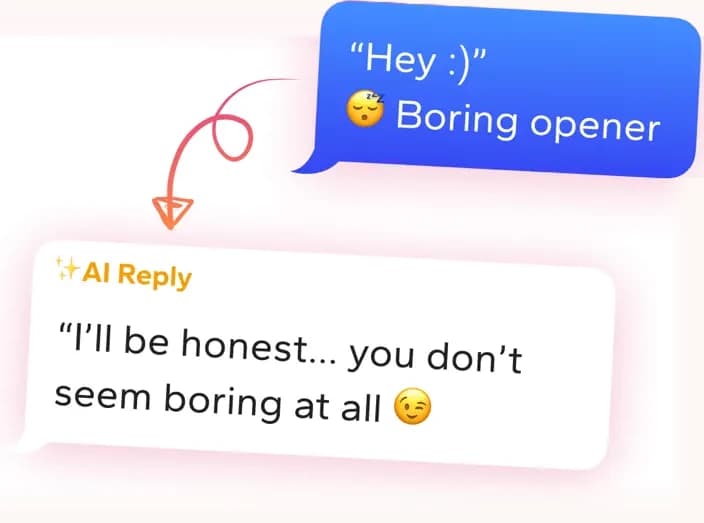
Get replies that sound like you
Screenshot the conversation in WingAI. It reads the vibe and gives you natural replies for this exact situation.
Try for freeWhat not to send
“Wow, one word? Okay then, I guess I'll stop bothering you.”
It turns her brief answer into an accusation, so she has to either apologize or ignore you, and ignoring you is easier.
“Hey are you there? Did I say something wrong? Just checking in!!”
Sent soon after a short reply, it treats a normal pause as a problem and makes a busy afternoon feel like a test she is failing.
“lol yeah ok, sounds good, anyway”
Echoing her minimal effort gives her a conversation with nothing in it, so there is no reason for her to pick it back up.
Frequently asked
- How do I reply when a girl sends one word back?
- Send something short that stands alone and needs no answer: a small story, a plan, or a light observation. Avoid questions and avoid commenting on her brevity. If she picks it up with more detail, keep going. If she stays brief, stop initiating and see whether she reaches out.
- Does a short reply mean she has lost interest?
- Not by itself. A single short message is thin evidence, especially during her workday or on a busy app. Look at the pattern over several exchanges. If she stays clipped even when you send something easy and fun, interest is likely low. If it varies, she may just be busy or a weak texter.
- Should I ask her why her replies are so short?
- No. Asking puts her on the spot and usually produces a defensive or vague answer. She already knows she is being brief. Better to change what you send, making it lighter and easier to answer, and let her response tell you what you need to know.
- What if she only goes short when I ask her questions?
- Then the questions are the problem, not you. Back off the quizzing for a while and share something about your day or a plan you have. When a conversation stops feeling like an interview, people who gave one word answers often loosen up and add their own details.
Mistakes to avoid
- Sending several questions in one message, which gives her a chore instead of an easy way to respond.
- Replying within minutes with a second or third message because the first was brief, which adds pressure to a quiet moment.
- Reading too much into one reply sent at a bad time, such as her workday or late at night, instead of watching the pattern across several days.
- Writing a long, heartfelt paragraph in response to one word, which highlights the gap in effort instead of closing it.
Real user feedback
“I overthink every text. Having three options and picking the one that sounds like me cut that spiral short.”
Sam R.
“She went cold mid-week and I had no idea what to say. The reply I sent felt natural and she picked the chat back up.”
Marcus T.
“I was skeptical at first. Then I tried it on a dry chat and the replies actually sounded like me, not a chatbot.”
Mazoonx
Get replies that sound like you
Screenshot the conversation in WingAI. It reads the vibe and gives you natural replies for this exact situation.
Try for free