How to reply when someone sends you an AI flirt response
Got a flirty message that sounds machine-written? Here is how to answer it with a pointed question, a light tone, and a clear read on whether a real person is t
A message that sounds machine-written usually lands in your inbox for a boring reason. The sender may be tired of openers that go nowhere, so they let a tool draft something smooth and hit send. Some people feel shy about their own writing and lean on polish as a crutch. Others paste the same warm paragraph into forty chats before lunch. Only the last case is a real problem, and you cannot tell which one you are dealing with from the first message alone.
Your goal is not to catch anyone. You are trying to find out whether a person is behind the screen and whether that person is interested in you specifically. That reframing changes your reply. A gotcha line is built to win an argument. A good reply is built to produce information, and it works whether the sender is a nervous human, a lazy one, or someone running a script.
Platform and timing matter more than people expect. On Hinge or Tinder, an opener often arrives hours after the like, and the sender may have forgotten what your profile said. A polished flirt that references nothing concrete might simply be the product of that gap. Answer within a day or so, while the match still feels fresh to both of you. Waiting four days to craft the perfect comeback hands the other person a reason to forget you exist, and the pause makes your reply read as a verdict rather than a conversation.
Most of what backfires here comes from guessing out loud. Accusing someone of using a tool puts them on trial, and a person who did use a tool will deny it while a person who did not will feel insulted. Neither response teaches you anything. Mirroring the flowery tone has its own cost, because you end up trading two smooth paragraphs that say nothing, and you feel the conversation going nowhere without being able to point at why. Quiet disappearing is fine if you are bored, but unmatching in a huff after one message skips the cheap test that would have told you more.
The response itself is your evidence. Look for texture: a reference to something you wrote, a small tangent, a joke that only makes sense in context, a typo they leave in. A real person engaging with a pointed question tends to answer the odd part of it, not the safe part. Another polished, vague paragraph that dodges your detail tells you the same thing a silence would. Slow replies are ambiguous, since people have jobs. Fast replies that ignore your question are not.
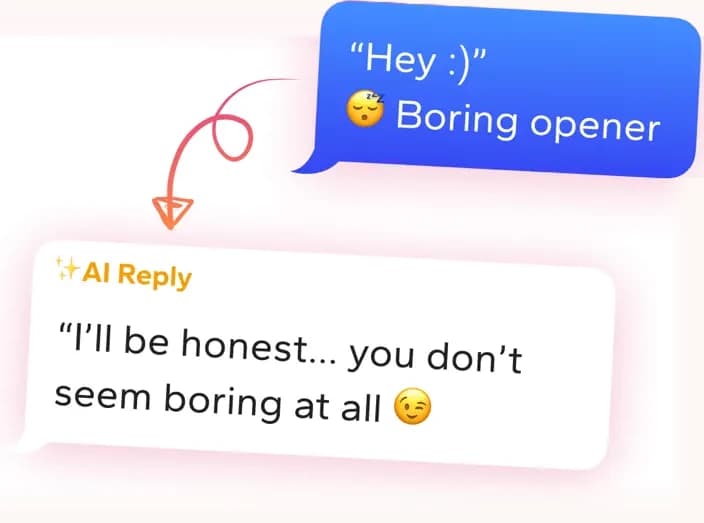
Get replies that sound like you
Screenshot the conversation in WingAI. It reads the vibe and gives you natural replies for this exact situation.
Try for freeAsking a question templates cannot answer
Pick one oddly specific thing from their profile and ask about the story behind it. A faded patch on a jacket in the third photo, a book they listed without explanation, a city that does not match the rest of their travel shots. Questions about hobbies in general or favorite foods can be answered by anyone with a paragraph of filler. A question about the weird detail needs the actual owner of that detail. Keep it short. One question, not a quiz. Long, demanding messages make even sincere people freeze, and you want the easy path to lead toward a real answer.
Keeping the tone warm, not suspicious
Write as if you are pleased to have matched and a little curious. A light joke about how smooth their opener was can work if it sounds amused rather than sharp, but you can also skip any comment about the message itself and just respond with interest. The person who wrote it may feel exposed already. Giving them room to relax costs you nothing and improves the quality of what you learn. If the sender is a real person who borrowed some help to get started, a friendly question lets them step out from behind it without having to confess anything.
Deciding when to stop investing
Give the conversation two honest exchanges. If your specific question gets a dodge and then another glossy compliment, you have your answer, and you do not need a third try or a final message explaining why you are leaving. Stop replying, or unmatch quietly if the app clutter bothers you. If they answer with an awkward, specific, human detail, even a clumsy one, keep going and respond to that detail directly. People who needed a push to stop performing often turn out to be better company than the ones whose first message was already perfect.
People also ask
- How do I reply to a flirty message that sounds like it was written by AI?
- Answer warmly, then ask one question about a specific, unusual detail in their profile. Skip any comment about how the message sounds. A real person will respond to the detail in their own voice, and a script will deflect with more polish. Either result tells you what to do next.
- Should I tell them I think their message was AI generated?
- No. You cannot prove it, and being wrong insults someone who did write it themselves. Even when you are right, an accusation makes the sender defensive. Let a specific question do the sorting instead. Their reply will show you more than any confrontation could.
- What if they just write that way naturally?
- Then your specific question will still work, because a real person answers it with details only they would know. Some people write in a polished style by habit, especially if they draft messages carefully. Judge them by how they handle a pointed question, not by how smooth the first line was.
- How long should I wait before replying?
- Within a day or two is a good window. Replying sooner is fine if you have an actual question ready. Waiting longer makes the exchange feel stale and tends to lose the sender's attention. Give them a similar window to respond, then let it go if nothing useful comes back.
Why these don't work
“Wow, that was a really smooth message. Did a chatbot write it?”
It turns a first exchange into an interrogation, and a real person who got help drafting will either lie or feel embarrassed enough to vanish.
“Thanks so much, that is so sweet! You seem amazing too. What are you up to this weekend?”
You are matching their polished, empty energy with your own, so the chat stays generic and you learn nothing about whether anyone is really there.
“Hold on, let me check if you are a bot. Tell me what you had for breakfast and the name of your first pet.”
Treating a dating match like a security checkpoint makes a real person feel suspected and gives a scripted sender easy canned answers to recite.
Pitfalls to avoid
- Replying with a long, clever message of your own, which hands a shy or busy person a bigger task than the one they just skipped.
- Quizzing them with several questions at once, so even a sincere sender picks the easiest one to answer and the test tells you nothing.
- Sending a follow-up explaining why you asked, which undoes the lightness of the first message and sounds like you are keeping score.
It doesn't sound like a bot
“She went cold mid-week and I had no idea what to say. The reply I sent felt natural and she picked the chat back up.”
Marcus T.
“I was skeptical at first. Then I tried it on a dry chat and the replies actually sounded like me, not a chatbot.”
Mazoonx
“I overthink every text. Having three options and picking the one that sounds like me cut that spiral short.”
Sam R.
Get replies that sound like you
Screenshot the conversation in WingAI. It reads the vibe and gives you natural replies for this exact situation.
Try for free