How to Reply on Bumble When She Asks About Your Childhood Memory
How to answer a Bumble question about your favorite childhood memory without going flat or oversharing, and how to keep the conversation moving from there.
She's asked your favorite childhood memory, which is a warm, open question. It's an invitation to tell a small true story, not a test of how deep you are. Most people either give a one-word answer that kills the thread, or they dump a long backstory that's hard to respond to.
What works is a short, specific memory, told with a little detail that shows what it felt like, followed by a light question back to her. That gives her something concrete to react to, and it hands the conversation back to her.
The goal of your reply is to make her want to answer the same question. If your answer is interesting enough, she'll tell you hers.
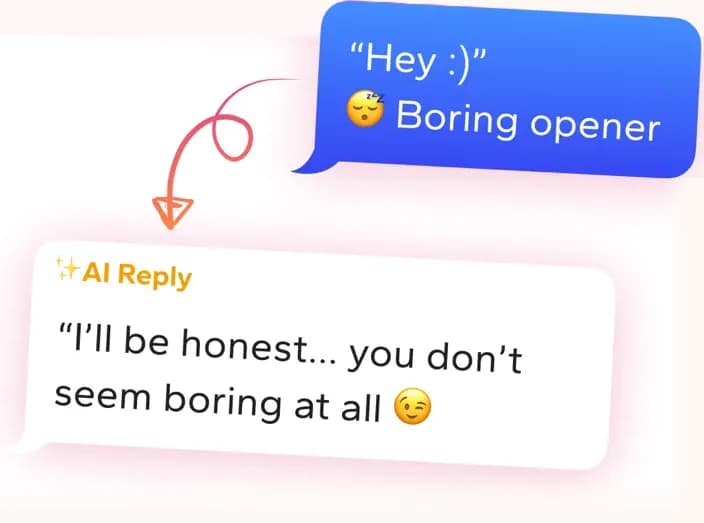
Get replies that sound like you
Screenshot the conversation in WingAI. It reads the vibe and gives you natural replies for this exact situation.
Try for freeBumble AI She already sent the first message. Screenshot it and get the reply.
She is asking for a story, not a résumé
A question about a favorite childhood memory is one of the easier openers on Bumble. It's a bit personal, but it's framed as nostalgic and fun, so she's probably hoping for a small story she can picture. Read the tone of her message. If it's playful with an emoji or a lowercase "random but", she wants something light. If she's already shared something of her own, she's reciprocating and expects the same level of openness back.
Don't treat it as a deep interview. She isn't checking whether you're emotionally mature. She wants to see what you remember and how you tell it. A specific detail, like the smell of a place or a particular silly thing a relative said, does more work than a grand statement about how the memory shaped you.
Pick one memory and let it be small
Choose one memory that's vivid and mostly happy, or at least has a funny or warm angle. Small and concrete beats impressive. A memory of your grandad teaching you to skim stones on a particular lake is easier to respond to than a memory of the best trip you ever took.
Keep the telling short, two or three sentences. Include one sensory or specific detail so there's something to ask about. Then stop. Leaving a little room is what lets her come in with her own.
Hand the question back before the message ends
End with something she can answer without effort. A question about her version of the same kind of thing works well, because she can pick any memory she likes. Something like asking what her version would be, or whether she was that kid who loved a certain thing, gives her an easy entry point.
Avoid questions that ask her to justify or explain herself, and avoid turning the question into a test. You're trying to keep the thread warm, so keep the question light enough that answering it feels like the natural next move.
Why these replies fail
“Camping lol”
It gives her nothing to react to and reads as a dismissive one-word answer that ends the thread.
“Honestly I think my favorite memory is when my parents split up and I had to grow up fast, it taught me a lot about resilience and who I am now.”
It jumps to a heavy, unfinished story in a playful exchange and puts her in the position of having to respond to something painful.
“What's yours? Like the real one, not the cute one. What did you learn from it?”
It turns a light question into an interview and asks her to do the heavy lifting before you've shared anything yourself.
Common mistakes
- Answering with a single word like "camping" or "Christmas" and nothing else.
- Writing a long paragraph that covers your whole childhood instead of one memory.
- Asking a question back that she has to think hard about, like a heavy philosophical one.
- Making the memory sound like a sad or heavy story when the question was light.
- Replying with a joke that dodges the question entirely.
Questions people ask
- Is it weird to answer a childhood memory question on a first match?
- No. It's a common question on Bumble and it's usually asked to get a conversation going. Answer with a short, light memory and a question back. Keep it under three sentences and you'll come across as easy to talk to, not as if you're oversharing.
- What if I can't think of a good childhood memory?
- Pick the first specific thing that comes to mind, even if it feels small. A particular food, a place you went every summer, or a silly habit a family member had all work. Vivid and ordinary usually beats impressive and vague.
- Should I ask her the same question back?
- You can, but make it easy to answer. Asking for her favorite version of the same kind of memory gives her a clear starting point. Avoid asking for her deepest or most meaningful memory on a first conversation, since that's a lot to answer casually.
- How long should I wait for her to reply to my answer?
- Give it a day before you follow up, since Bumble conversations often move in bursts. If she hasn't replied after a day or two, you can send one light message on a different topic. If there's still nothing after that, let the thread go and move on.
What people say after using WingAI
“She went cold mid-week and I had no idea what to say. The reply I sent felt natural and she picked the chat back up.”
Marcus T.
“I overthink every text. Having three options and picking the one that sounds like me cut that spiral short.”
Sam R.
“I was skeptical at first. Then I tried it on a dry chat and the replies actually sounded like me, not a chatbot.”
Mazoonx
Get replies that sound like you
Screenshot the conversation in WingAI. It reads the vibe and gives you natural replies for this exact situation.
Try for free