How to start a conversation on Tinder that actually gets replies
Learn how to open a convo on Tinder with a message built around her profile, plus the timing, follow-up rules, and openers that get ignored.
A match message lands in a crowded inbox. She may have a dozen unread notifications, a few half-finished chats, and a phone she is checking between other things. Whatever you send has to be understood in a glance, because she is skimming, not studying. Before she reads a word, she has already formed a rough guess about whether a real person looked at her profile or whether she is one of many names on a swiping spree. That guess colors how much effort she is willing to spend on a reply.
Your aim is narrow. You are not trying to charm her in one message, and you are not trying to explain who you are. You want her to answer, and that is all. The way to get there is to hand her something small and specific to respond to, ideally a detail only someone who read her page would mention. A line from her bio, the odd object in the corner of a photo, a place she tagged, a hobby she listed. Pick the one that made you curious, not the one that seems safest, because curiosity is hard to fake and easy to hear.
Tinder changes the math in a few ways. Matches are cheap, so people carry on with several at once, and the ones who feel like work get left for later and then forgotten. Timing matters more than most people admit. A message that arrives on a quiet weeknight evening, when she is likely sitting on a couch with the app open, gets read with more patience than one that shows up mid-commute or in the small hours. Sending right after a match can also work against you if you rush it, since a hurried message tends to be the generic one. It is fine to wait an hour and write something better.
Most openers fail for predictable reasons. Compliments on looks give her nothing to build on, and she has heard them from half her matches. Messages with no question leave her holding a statement she has no reason to answer. Questions that are too big, like asking about her life goals, feel like homework. Questions that are too vague, like asking what she is up to, force her to invent a topic. And jokes that lean on her profile in a way she could read as mocking can end the exchange before it starts. A good test is whether the message sounds like something you could say aloud to a stranger at a gathering without making them uncomfortable.
When she does reply, read the length and energy of what she sends. A short answer with a question back is an invitation, so match her pace and keep going. A one-word reply with nothing returned usually means she is lukewarm or busy, and piling on extra questions will not change that. If days pass, a single light follow-up tied to your first message is reasonable. After that, let it rest. Silence after two messages is an answer, and moving to your next match costs you nothing.
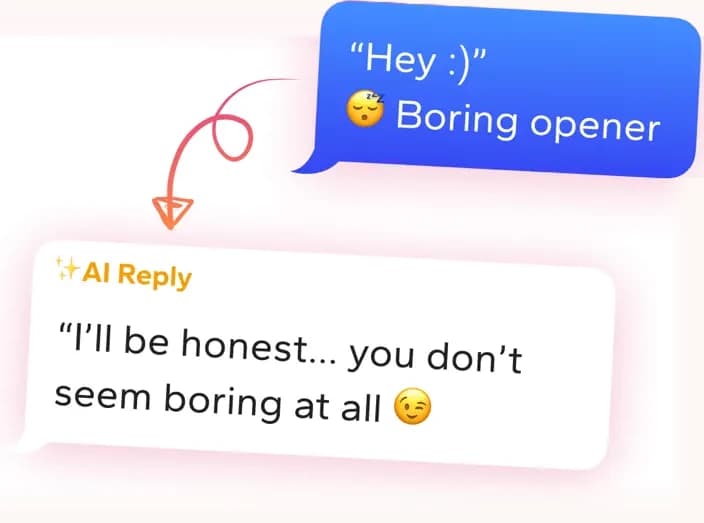
Get replies that sound like you
Screenshot the conversation in WingAI. It reads the vibe and gives you natural replies for this exact situation.
Try for freeTinder AI Screenshot the photos and get an opener for that match.
Why her profile is your best material
Her profile is a list of things she chose to show, which means she already thinks they are worth talking about. A prompt answer, a caption, a job title, a hobby listed in the bio, all of it is an invitation. Scan for the detail that puzzles or amuses you, then ask about the part you cannot guess from the outside. Asking what her favorite trail is gives her little to work with. Asking why she picked a particular spot for a photo, or what happened right before a picture was taken, lets her tell a small story. Specific curiosity reads as attention, and attention is the thing most messages lack.
Matching the question to the detail
The question should be sized to the detail you noticed. A photo with a dog invites something light and quick. A bio line about a career change invites more, but only if you ask gently and without pressure. If the detail is thin, do not stretch it into a long question, since that feels forced. Keep it to a sentence or two of context and one clear ask. Avoid questions with an obvious yes or no, because she can answer and leave. Aim for something she can answer in her own words without having to think hard, the way you would ask a friend of a friend at a party.
Timing and the follow-up window
Weeknight evenings tend to find people with the app open and some patience to spare. Late-night bursts and messages fired off the second you match often look automatic. If she does not reply, give it a few days before deciding anything, since many people open Tinder only now and then. One follow-up is fine if it ties back to what you first wrote and stays short, with no apology and no new interrogation. A third message just stacks up in her notifications. If a chat starts and then fades after a handful of exchanges, take that as information and spend your energy on a match who is answering.
Messages that backfire
“Hey, you're really cute. How are you doing?”
It could be sent to any match without a single change, so she has no sign anyone looked at her profile and no reason to write more than 'thanks' or 'good'.
“I see you like traveling. That's awesome. We should travel together sometime lol”
It points at something in her profile but asks her nothing, then jumps to a plan she has not agreed to, which feels presumptuous from a stranger.
“What's the story behind that photo of you at the lake? Also what's your deal? Haha”
The first question gives her something real to answer, but the vague second one turns a friendly opener into an interrogation and muddies what she is supposed to reply to.
Where people go wrong
- Sending a message that never mentions anything from her profile, so she cannot tell whether you read it or swiped on a photo.
- Ending with a statement instead of a question, which leaves her with nothing to answer and an easy reason to close the app.
- Firing off a quick message the moment you match, instead of taking a few minutes to find a detail worth asking about.
- Sending a third or fourth message after she has stayed quiet, which turns a light nudge into pressure.
Common questions
- Is a joke opener better than asking a question?
- A question is usually safer, because it guarantees she has something to answer. A joke works only when it grows out of something specific in her profile and she can tell you meant it kindly. If you have to strain to make it funny, skip it and ask something you are curious about.
- How long should my first message be?
- Aim for two to four sentences. That is enough to show you read her profile and to include one clear question, without burying her in text. A single line often feels thrown together, while a long paragraph feels like pressure before she knows anything about you.
- Should I compliment her appearance in my opener?
- Skip it. She has likely heard it from many matches, so it adds nothing and gives her nothing to answer. Comment on something she wrote, a place she mentioned, or an interest she listed. That shows you read past the photos and gives her a real topic.
- What if she takes a week to reply?
- Do not assume she lost interest. Plenty of people open Tinder only now and then. Respond normally to what she said, keep it light, and do not mention the delay or ask where she has been. Bringing it up makes her feel scolded and sours a conversation that was just starting.
From our users
“I was skeptical at first. Then I tried it on a dry chat and the replies actually sounded like me, not a chatbot.”
Mazoonx
“I overthink every text. Having three options and picking the one that sounds like me cut that spiral short.”
Sam R.
“I always freeze on the first sentence. This gets me past that blank box so I actually hit send.”
joejoe4567
“I'm busy and half the profiles give you almost nothing to work with. WingAI gets me a solid first line fast without me staring at the screen for ten minutes.”
Ralph
Get replies that sound like you
Screenshot the conversation in WingAI. It reads the vibe and gives you natural replies for this exact situation.
Try for free