Keep conversations going without asking questions
Learn to maintain text momentum by sharing ideas, reactions, and thoughts instead of relying on questions to drive the conversation forward.
Most people default to questions when the conversation stalls because questions feel safe. They put the ball in her court and buy time. But back-to-back questions make you sound like you're interviewing her, not connecting with her.
The move is to make statements instead. Share a thought, react to what she said, add context about yourself, or build on her idea. These moves keep the thread alive without needing her to volunteer new information.
Good replies do two things at once. They show you were actually listening to what she said, and they give her something real to respond to. That's how a conversation feels like a conversation and not an interrogation.
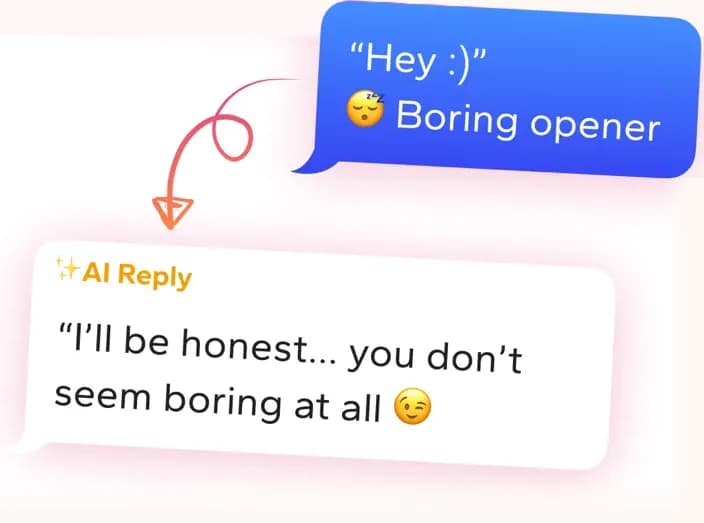
Get replies that sound like you
Screenshot the conversation in WingAI. It reads the vibe and gives you natural replies for this exact situation.
Try for freeShe's giving you an opening, not waiting to be quizzed
When someone mentions something personal like a fear or a hobby, they're signalling interest in talking about it. But they're not handing you a survey form. They're inviting you into the thing itself.
If she says she's scared of heights, she's not waiting for you to ask if she's ever rock climbed. She's hoping you'll either relate to the fear, offer a real thought about it, or share something that connects to it. The conversation dies when you turn her statement into a question mark.
Match her stakes with your own reaction
A good reply meets her halfway. If she's vulnerable about something, don't pump her for more details. Instead, acknowledge what she said and add texture from your side. If she mentioned rock climbing, you could share that you get the height thing, or explain why you've been hesitant, or describe what appeals to you despite the fear.
The move is to reciprocate the realness, not extract it. She'll naturally elaborate or ask about you when she feels like you're actually in the conversation.
Wait for a natural pause, then shift slightly instead of drilling
After she responds to your reaction, resist the urge to ask a follow-up question. Instead, take what she said and extend it. If she explains her own experience with heights, you could share what you'd want to do first, or a friend's story that reminds you of hers, or what you're actually afraid will happen.
Shift the angle rather than dig deeper. This keeps momentum going without making it feel like you're interrogating her. When she's ready to steer, she will.
Why these replies fail
“omg that's cool! have you climbed a lot? where do you usually go?”
Two questions in a row turns the conversation into a Q&A where she's the subject and you're the interviewer.
“heights are scary”
Too vague and generic. You're agreeing but not actually saying anything about yourself or engaging with what she shared.
“i've always wanted to try that. when are you free to go together lol”
Jumps straight to logistics and assumes she's already invested in doing this with you instead of building rapport first.
Common mistakes
- Asking 'have you tried it?' or 'where do you climb?' instead of sharing your own stake in the thing
- Going quiet after she responds because you think questions are the only way forward
- Throwing out a statement but making it so vague she has nothing to grab onto
- Switching topics entirely instead of staying in the lane you just opened
- Asking multiple questions in a row to fill silence
Questions people ask
- Won't statements just make the conversation about me instead of her?
- Not if your statements are responses to what she actually said. You're adding your side of the same topic, not pivoting. That builds connection. Questions that don't relate to her point do the opposite. They feel like you weren't listening.
- What if I don't have a related thought or experience?
- Then describe what you find interesting about what she said. Explain why it matters to you as a concept. If she mentions rock climbing, you could say 'i like that you do something that actually scares you' instead of asking if she's done it long.
- How long should I wait if she doesn't reply to my statement?
- Give it 24-48 hours in normal circumstances. If she hasn't replied by then, a short follow-up is fine, but keep it short and don't ask another question. If you get no response twice in a row, move on. She's not interested.
- Is it ever okay to ask questions?
- Yes, but not as filler. Ask when you actually need information that matters to the next step, or when she's asked you something that requires a question back. Lead with statements, use questions strategically.
What people say after using WingAI
“Used it for a couple hours and set up a date the same night. Not even kidding.”
Nikola2214
“I always freeze on the first sentence. This gets me past that blank box so I actually hit send.”
joejoe4567
“I was skeptical at first. Then I tried it on a dry chat and the replies actually sounded like me, not a chatbot.”
Mazoonx
Get replies that sound like you
Screenshot the conversation in WingAI. It reads the vibe and gives you natural replies for this exact situation.
Try for free