How to mention your dating past without seeming like baggage
Learn when and how to bring up past relationships early without creating red flags or scaring someone away.
Early dating sits in a weird middle ground. You want to be honest, but you also don't want someone running because they think you're still stuck on an ex or have unresolved drama. The trick is knowing what to reveal, when to reveal it, and how to frame it so it reads as context, not warning signs.
When someone asks about your past or hints they want to know more, that's your opening. But "opening" doesn't mean dumping a full relationship history. A good reply shows you've moved on, learned something, and aren't carrying the past into this new thing. It answers what they actually want to know, not everything you're worried about.
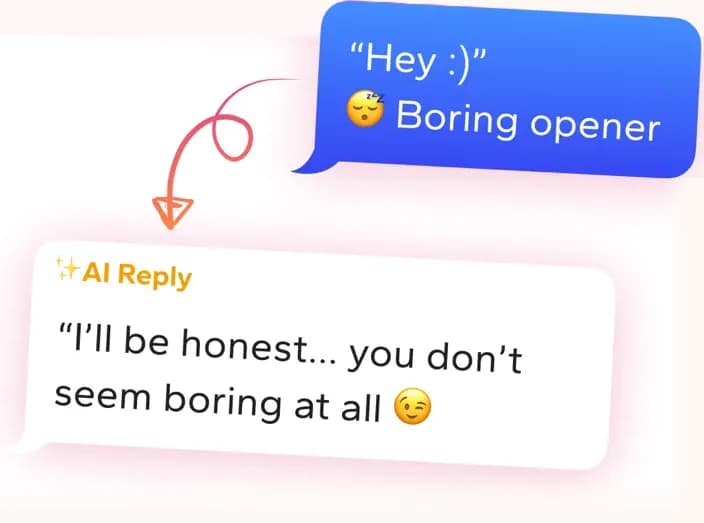
Get replies that sound like you
Screenshot the conversation in WingAI. It reads the vibe and gives you natural replies for this exact situation.
Try for freeRizz AI Screenshot the chat and get the next message for this person.
What she's actually testing when she asks
When someone asks about your past relationships early on, they're usually checking three things: Are you still tangled up with someone? Do you have unresolved anger or hurt? Will you handle a breakup like an adult if this doesn't work out?
She's not asking for a deposition. She's listening to tone more than facts. If you sound bitter, confused, or like you're still processing a recent split, that's what registers as red flag, not the fact that you had a serious relationship. A straightforward answer that shows you learned something and moved on signals maturity, not trauma.
The move that separates safe from scary
A good reply acknowledges the past briefly, shows you've landed somewhere because of it, and pivots to the present. The structure is simple: what happened, what you got out of it, what you're looking for now. You're not hiding it. You're just not centering it.
Don't soften it with too much explanation or apology. Don't frame it as "I'm still healing" or "I have trust issues because of..." That plants a seed of uncertainty. Instead, talk about what you learned about yourself, what you now know you want, or what you do differently now. It's the difference between sounding like you're carrying something versus someone who went through something.
When to stop volunteering information and wait
Mention your past only when directly asked or when it's naturally relevant. If she hasn't asked, don't bring it up in the first three dates. Proactively listing your relationship history reads as either defensive or like you're prepping her for disappointment.
If the conversation does go there and you give an answer, then stop. Don't add "but I was also seeing someone in 2019" or "though there was this other thing." One clear answer is enough. If she wants more detail, she'll ask. If she doesn't, she's satisfied. Overstating the past by volunteering extra details is often where people lose her.
Why these replies fail
“Yeah, I was with someone for 3 years. Her name was Sarah. We met at work and it was messy because she cheated on me, but honestly looking back I wasn't being a great partner either so I get it.”
Dumps too many specifics (name, timeline, the drama) and sounds like he's still processing rather than settled.
“I don't really like talking about exes, it feels disrespectful to bring them up. But I've had a few relationships, nothing serious.”
Evasiveness makes it sound like there's something he's hiding or ashamed of, which creates more suspicion than honesty would.
“I have some baggage from my last relationship, so I'm still working through some trust issues. But I'm trying to be better about it.”
Frames himself as damaged goods and asks her to carry emotional labor before they've even started, which is a lot of pressure this early.
Common mistakes
- Listing exes like a resume, including names, dates, and specific breakup details
- Leading with the dramatic part ("My last relationship was a total mess") before establishing you've moved past it
- Oversharing to prove you're over it, which signals you're still thinking about it
- Being vague or evasive, which makes them think you're hiding something worse
- Bringing up an ex's name or details unprompted, before she's asked
Questions people ask
- Should I mention an ex if she doesn't ask?
- No. Wait for her to bring it up. If you volunteer it unprompted, it sounds like you're either still thinking about them or bracing her for something. Let it come naturally through conversation. If the past is relevant later, it'll make sense to mention it then.
- How much detail should I give about why a relationship ended?
- One sentence max at this stage. Something like "We wanted different things" or "We grew in different directions." If she wants more, she'll ask. Right now she's checking if you're bitter or still stuck, not asking for a therapy session.
- What if I'm recently out of something serious?
- Be honest about the timeline but frame it as context. "I was with someone until recently, so I'm taking things slowly" shows you're being thoughtful, not like you're rebounding or not over it. Adjust what you're looking for to match where you actually are.
- Is it better to say I have exes or that I've never had a serious relationship?
- Whichever is true. Both are fine. What matters is how you talk about it. If you've had relationships, mention them straightforwardly if asked. If you haven't, no need to apologize for that either. She's checking if you can handle relationships maturely, which applies either way.
What people say after using WingAI
“I overthink every text. Having three options and picking the one that sounds like me cut that spiral short.”
Sam R.
“I was skeptical at first. Then I tried it on a dry chat and the replies actually sounded like me, not a chatbot.”
Mazoonx
“Used it for a couple hours and set up a date the same night. Not even kidding.”
Nikola2214
Get replies that sound like you
Screenshot the conversation in WingAI. It reads the vibe and gives you natural replies for this exact situation.
Try for free