Ask a friend out without losing the friendship
How to confess feelings to a friend and make a move that protects the connection if they say no.
You've been close to this person for a while, and now you want to know if there's something more there. The risk is real: if you ask and they don't feel the same way, things get weird. The friendship feels fragile.
But here's what matters: most friendships survive the ask. What doesn't survive is ambiguity, mixed signals over months, or pretending you're fine when you're not. A clean, honest move is actually the thing that keeps friendships intact.
A good reply does two things at once. It signals that you see them as a person worth the risk, not a backup plan. And it gives them an easy way to say no without feeling like they broke something. You're not cornering them or making it weird. You're just being direct.
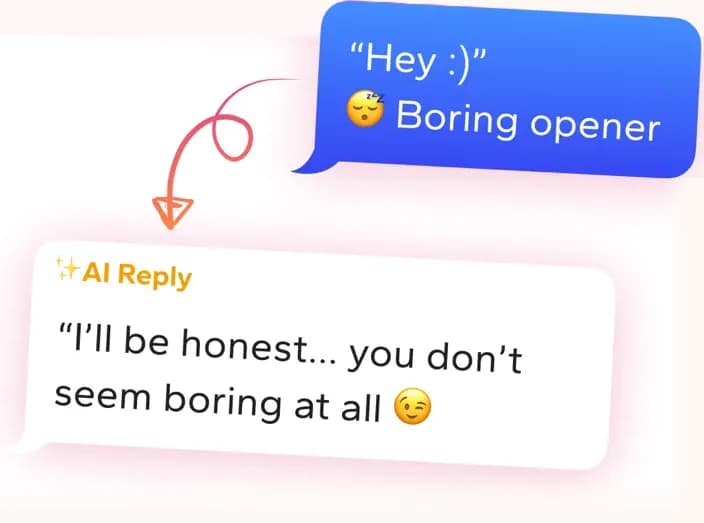
Get replies that sound like you
Screenshot the conversation in WingAI. It reads the vibe and gives you natural replies for this exact situation.
Try for freeRizz AI Screenshot the chat and get the next message for this person.
She hasn't said no yet, so the friendship isn't in danger
If she hasn't rejected you, you're reading into silence or mixed signals. That's different. A friend who laughs at your jokes, texts you back, and makes time for you is not rejecting you. She might be interested, she might not be, but she hasn't decided anything.
What matters is that you can't keep reading her behavior as signs. You can't keep scanning for evidence that she likes you. That wears the friendship down faster than one honest question ever will. Right now the friendship is intact. Your job is not to protect something that's already fine. Your job is to stop wondering and get an actual answer.
Lead with the ask, not the justification
Don't spend energy explaining why you like her, why it won't be weird, or why the friendship is strong enough to handle it. Those things matter, but they come after the ask, not before. Leading with justification makes it sound like you're trying to convince her, which makes her defensive.
Instead, state what you want simply. 'I'd like to take you out.' That's it. Then tell her you value the friendship and you're not trying to pressure her. Those two sentences protect it. Everything else is noise that makes her feel like she's being sold something.
Send it when you're calm and she can actually think
Don't send this at 11pm, in a voice memo, or when you're emotional. Don't send it right after she's mentioned dating someone else or right after a fight. Send it in the daytime, in writing, when you're thinking clearly and she has space to read it without an audience.
If she doesn't respond for a few days, that's fine. She's probably thinking. Don't follow up or explain yourself more. If she says no, accept it the same day. Say something like 'I appreciate you being straight with me, and I'm glad we're friends.' Then actually mean it. Don't punish her with distance or sullenness. That's when you lose the friendship, not when you asked.
Why these replies fail
“I know we're just friends, but I can't stop thinking about you. I think I'm falling for you and I don't want to keep pretending. Please don't hate me.”
It puts her in the position of comforting you and managing your feelings instead of just giving you an honest answer about her own.
“You're amazing and so many guys would be lucky to have you. I think we could really work, and our friendship is solid enough to handle this. Want to grab dinner and see what happens?”
The long justification and 'see what happens' makes her feel pressured to try something she's not sure about rather than just saying yes or no.
“Hey, random thought, but would you ever want to hang out sometime? Like, more than just as friends? I mean, only if you want to, haha.”
The hedging ('random thought,' 'haha,' 'only if you want') signals that you don't actually believe in the ask, which makes her second-guess whether you mean it.
Common mistakes
- Framing it as a test or trial ('just to see how it goes') makes it sound like the friendship isn't enough, which makes rejection sting more
- Asking in a crisis moment or when they're vulnerable puts them in a position where they feel obligated to protect your feelings
- Hinting for months instead of asking directly leaves them guessing and exhausted, poisoning the friendship before they even know what's happening
- Making a big romantic gesture before asking puts pressure on them to reciprocate the energy level, not the actual feeling
- Softening it too much ('I know this is weird but...') signals that you already think you've ruined something, which plants the idea in their head
Questions people ask
- What if she says no? Is the friendship actually ruined?
- Not if you handle it right. The friendship survives when you accept the no without punishment or drama. Don't go distant, don't joke about it compulsively, don't try to 'stay friends' while secretly hoping she changes her mind. Just treat her like the friend she is. Most people respect that move.
- How long should I wait for a response?
- Give her at least 24 to 48 hours before you worry. She's probably confused, thinking it through, or nervous about your reaction. A week is still normal. Don't send a follow-up message or change your approach. Your original message was clear. Let her respond on her timeline.
- Should I ask in person or over text?
- Text is fine, especially if you're not in regular face-to-face contact. In person works too, but it's harder for her to think and harder for her to say no without feeling guilty. Text gives her space. Either way, keep it brief and direct. Don't make a scene.
- What if we see each other all the time? Do I have to be weird around her after?
- No. Act normal. Don't treat her differently, don't make a lot of eye contact to gauge her feelings, don't bring it up again unless she does. The faster you move past it, the faster the friendship feels normal again. Awkwardness only lasts if you keep feeding it.
What people say after using WingAI
“I was skeptical at first. Then I tried it on a dry chat and the replies actually sounded like me, not a chatbot.”
Mazoonx
“I overthink every text. Having three options and picking the one that sounds like me cut that spiral short.”
Sam R.
“Used it for a couple hours and set up a date the same night. Not even kidding.”
Nikola2214
Get replies that sound like you
Screenshot the conversation in WingAI. It reads the vibe and gives you natural replies for this exact situation.
Try for free