Texting 'Love you' vs 'I love you': What the difference really means
Learn what casual 'love you' signals versus formal 'I love you' over text, and how to read the shift between them.
When someone switches from 'love you' to 'I love you' over text, or the other way around, it's not random. The casual version feels lighter, more habitual, something you might say to a friend or at the end of a conversation string. The formal version is deliberate. It lands differently because it sounds like a statement instead of a reflex.
Reading the shift matters because it tells you about intention and momentum. If she drops the 'I' and starts texting 'love you', she might be getting more relaxed and natural with you. If she adds it for the first time, she's likely being more intentional about what she's saying. The good reply doesn't need to mirror her exactly or overthink the grammar. It just needs to match her energy without running away from it.
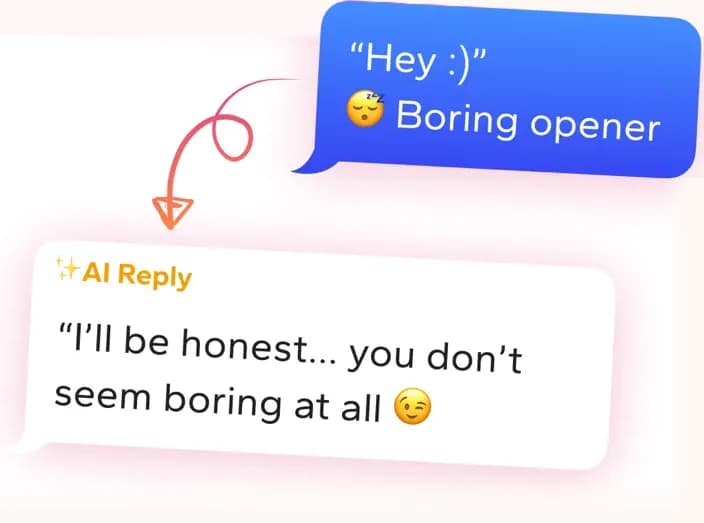
Get replies that sound like you
Screenshot the conversation in WingAI. It reads the vibe and gives you natural replies for this exact situation.
Try for freeTexting AI Screenshot the thread on your phone and get the next text.
Informality signals growing comfort not retreat
The drop of 'I' feels informal because it is. 'Love you' reads the way people actually talk when they're comfortable. It comes at the end of conversations, in moments that don't need ceremony. When someone switches to this from 'I love you', they're usually getting easier with you, not pulling back. The pattern matters more than a single text. If she's been saying 'I love you' and suddenly texts 'love you' three times in a week, that's a real shift toward natural comfort. One casual text after weeks of formal ones doesn't mean the feeling changed, just that she wasn't being careful that moment.
Match her tone and directness not her exact phrasing
You're not trying to match her grammar. You're matching her directness and warmth. If she's being casual and easy, your reply should feel the same way. Don't suddenly go formal on her or make a production of your response. If she's being deliberate and clear, don't undercut that by joking or deflecting. The move is to stay in the same room emotionally that she just entered. You can say it different ways and still land the same feeling. The thing that kills momentum is when she goes soft and you go stiff, or vice versa.
Respond within hours not days to avoid signaling hesitation
Send it within an hour if you're awake, or the next morning if she texted late. Don't sit with it for days while you decide between versions. The delay signals doubt, not thoughtfulness. You don't need to perfectly mirror her phrasing. Just pick whichever version feels natural to you when you write it. If you normally say 'I love you', say that. If you're more casual, 'love you' is fine. Consistency matters more than one perfect text. If she brings up a difference later, that's a conversation you can have. But making a power move out of grammar is how you create distance when she was trying to close it.
Why these replies fail
“Haha love that, you're amazing”
Dodges the actual thing she said by reframing it as a compliment, which makes it look like you're scared of the moment.
“I love you too, always and forever”
Goes theatrical when she was being casual, which swings the intensity in a way that creates pressure instead of connection.
“[read but no reply for 8 hours]”
Overthinking which version to use or whether to respond at all sends the signal that her words mattered to you differently than they should have.
Common mistakes
- Matching her format exactly as a way to seem safe, when you should match her feeling instead
- Spiraling about which version means more, when the real signal is consistency over time
- Replying with something jokey or deflecting because the directness made you uncomfortable
- Waiting to say it back because you're not sure which form to use
- Reading a single 'I love you' as a commitment escalation when it might just be how she talks
Questions people ask
- Does 'love you' mean less than 'I love you' when she texts it?
- Not necessarily. People have different texting styles. Some people always say 'I love you' formally, others naturally drop the pronoun. What matters is whether she's consistent and whether the feeling behind it is real. One text doesn't tell you much. The pattern over weeks does.
- Should I wait for her to say 'I love you' first if I'm not sure where she stands?
- Not if you know you feel it. Holding back creates distance and awkwardness. Say it when you mean it, in whatever form feels honest to you. Her response will tell you what you need to know without you having to guess.
- What if she says 'love you' and I say 'I love you'? Does that create a mismatch?
- Not if both statements are true. You don't need to perform her texting style. Consistency is about being yourself over time, not copying someone else's grammar in a single reply.
- If she switches from 'I love you' to 'love you', does that mean she's pulling back?
- Not usually. Most of the time, it means she's getting more relaxed with you. People tend to drop formality as comfort goes up, not down. If her behavior changes in other ways, that's worth noticing. One text switch usually isn't the signal.
What people say after using WingAI
“She went cold mid-week and I had no idea what to say. The reply I sent felt natural and she picked the chat back up.”
Marcus T.
“I overthink every text. Having three options and picking the one that sounds like me cut that spiral short.”
Sam R.
“I was skeptical at first. Then I tried it on a dry chat and the replies actually sounded like me, not a chatbot.”
Mazoonx
Get replies that sound like you
Screenshot the conversation in WingAI. It reads the vibe and gives you natural replies for this exact situation.
Try for free