Snapchat opener for a girl who is a journalist
How to open a Snapchat conversation with a journalist: read what her work signals, avoid the lines that read as pitches, and time your follow-up well.
A journalist on Snapchat has spent her working life being approached by people who want something from her. Editors pitch her, sources flatter her, strangers ask her to look into their grievance. So the first thing she checks is whether you want her to do something for you. A message that reads as a request for a favour, a story tip, or a free opinion gets filed as work and left unanswered.
What she notices first is whether you have a reason to write that is about her as a person. Her profile, her stories on Snapchat, a visible interest outside work, a city she mentions, a show she watches. If there is something concrete you can respond to, you have an in that is not her job. If there is nothing, a plain, low-stakes message does better than a clever one. Clever lines are exactly what people in her position have learned to distrust.
Good openers here are short, easy to answer in ten seconds, and give her something to reply to that is not work. They do not mention her article, her beat, or her byline unless she has brought it up first.
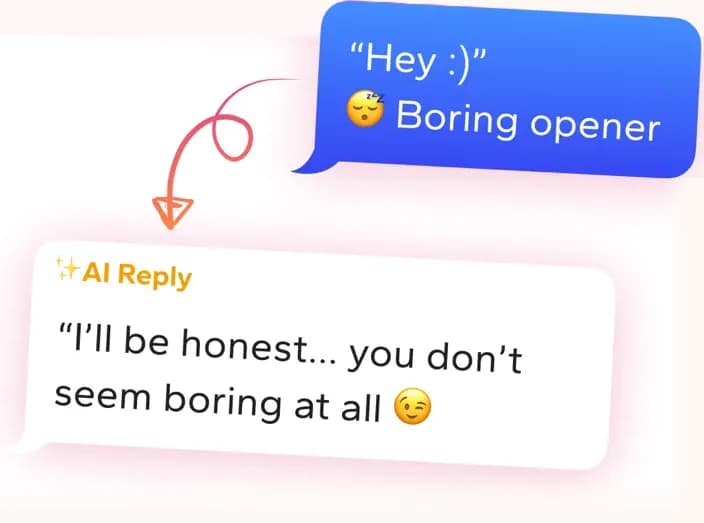
Get openers that sound like you
Screenshot the conversation in WingAI. It reads the vibe and gives you natural openers for this exact situation.
Try for freeRizz AI Screenshot the chat and get the next message for this person.
Her job is the first thing she thinks about
A journalist reads a new Snapchat contact through her work before she reads them as a person. If her bio, her stories, or her location point to a beat, she will assume an approach has an angle. The safest read is that a message about her job will be treated as a pitch until proven otherwise. That does not mean you cannot mention her work at all. It means the work cannot be the reason you wrote.
Watch what she shows on Snapchat. A dog, a meal, a walk, a complaint about a train, a book she is stuck on. These are the parts of her day that are not on the record. Respond to one of those and you are talking to her, not to the reporter. If everything she posts is work-adjacent, the honest read is that she does not share much personal life on the app, so keep the first message light enough that it costs her nothing to answer.
Answer the thing she put out, then stop
Whatever your opener is responding to, it needs to be a single clear thing that she can answer in one or two lines. A question that asks her for an opinion on her own book, a theory about her city, or a recommendation she has to think about sets her up to either write a paragraph or skip you. Both outcomes are bad. The better move is to say what you noticed and leave a small opening, so the answer is easy for her and the conversation can carry itself from there.
Also avoid stacking two things at once. A message that mentions the book, the city, and her job tells her you are checking boxes. One specific observation is enough. If you have a second thing you really want to know, hold it for the reply, after she has shown she is willing to talk about anything outside work.
The week of silence matters more than the text
Journalists get a high volume of messages and often reply in batches, sometimes days later, sometimes never. A missing reply in the first twenty-four hours tells you very little. Send one message and then leave it. If a reply arrives later, answer in the same tone and length she used, so she does not feel she has to match your energy.
If there is still nothing after a week, the message has done its job or it has not, and sending another will only make the silence louder. A single follow-up a few days later, written as a fresh observation rather than a reminder, is reasonable. After that, let it go, and do not chase her through another app or ask a mutual contact to vouch for you.
Why these openers fail
“Hey, I read your piece on the council budget last week and it was really sharp. Would you ever be up for grabbing a coffee and telling me more about how that stuff works?”
It opens on her byline, asks for free professional time, and makes a coffee the first ask, so she will read it as a source being cultivated.
“Hi! Saw you're a journalist, I've got a story you might find interesting about a landlord in my building. Can I send you the details?”
It treats her as a tip line before any personal contact exists, and most journalists will ignore a message like this or flag it as a pitch.
“Your stories are so good, I always read them on the train. Do you think the reporting on local government is ever going to get better or is it just going to keep being the same?”
The flattery is about her work, and the question asks for a considered opinion on a broad topic, which is a lot of effort to hand someone you have never spoken to.
Common mistakes
- Opening with a compliment about her writing or her byline, which tells her you looked her up and that you want something from her
- Asking her to look into a story, a tip, or a complaint in the first message
- Sending a long message that asks her to do the work of working out what you want
- Using the paperback or caption as a hook but then asking a question she cannot answer without effort
- Following up within a few hours and treating her silence as a question that needs an answer
Questions people ask
- Is it ever okay to mention that she is a journalist in a first message?
- It is okay to be aware of it, but it should not be the thing you lead with. If she has said something about her work on Snapchat herself, you can respond to that casually. If you only know it from her bio, keep the opener about something you can see that is not her job. Once the conversation has a personal footing, she may bring up her work, and you can follow her lead.
- What if she posts mostly about work?
- Then she probably does not use Snapchat for much personal life, and the honest approach is a low-stakes message that asks nothing of her. A short observation about something she shared, with no question attached, gives her room to reply without feeling she has to produce an answer. If she does not respond, that is information.
- How long should I wait before sending a second message?
- A few days is a reasonable gap, and a week is a reasonable upper limit before you let it go. Journalists often reply in batches, so silence in the first day means very little. Make the second message a fresh observation rather than a note asking whether she saw your first one.
- What if she replies but only with one word?
- Match her length and let the conversation stay small. One word usually means she is busy or does not want to go far, not that she is rejecting you. Reply briefly, and only ask a question if it is easy to answer. If the pattern continues over several exchanges, it is fair to conclude she is keeping it at arm's length.
What people say after using WingAI
“I'm busy and half the profiles give you almost nothing to work with. WingAI gets me a solid first line fast without me staring at the screen for ten minutes.”
Ralph
“I always freeze on the first sentence. This gets me past that blank box so I actually hit send.”
joejoe4567
“My openers used to be boring. Now I reference something from her profile and people actually write back.”
Aiden K.
Get openers that sound like you
Screenshot the conversation in WingAI. It reads the vibe and gives you natural openers for this exact situation.
Try for free